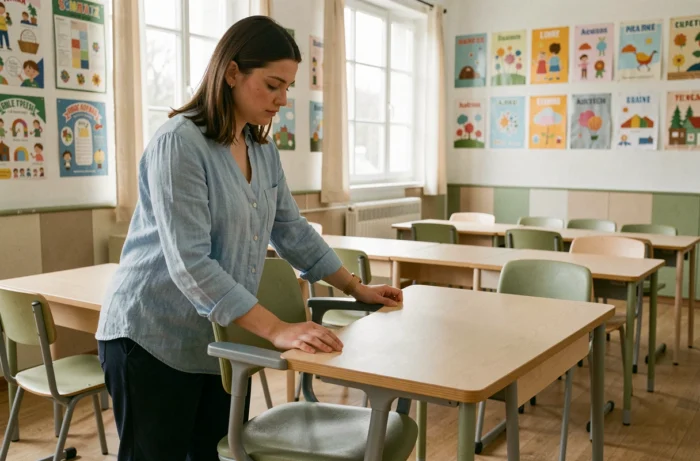
School furniture refers to all the seating, work surfaces, and storage used in educational institutions. Its role goes beyond mere utility: the height of a chair, the depth of a tabletop, or the tilt of a backrest affect students’ posture for several hours a day. Choosing the right school furniture involves balancing dimensional, mechanical, and regulatory constraints that do not always overlap.
Body incompatibility and fixed furniture: the problem that catalogs do not solve
A study published in 2024, involving 149 students, found ergonomic issues among the majority of participants using fixed desks and chairs. This observation is not limited to higher education: even in primary school, the variation in heights makes a one-size-fits-all approach unsuitable for a significant portion of students at the same level.
In practice, two children of the same age can have a height difference of more than fifteen centimeters. Equipping an entire class with a single reference for tables and chairs means accepting that a fraction of the students will work in a degraded posture. Adjustable solutions or those combining multiple heights within the same room better address this morphological diversity.
Manufacturers like Cap San offer modular ranges designed for communities, with adjustment mechanisms compatible with intensive use in school environments.
Standard NF EN 1729: what the regulatory framework covers (and does not cover)
The NF EN 1729 standard is the European reference for the sizing of school furniture. It is divided into two complementary parts.
- EN 1729-1 defines the functional dimensions of chairs and tables (seat height, depth, work surface height) based on height ranges, categorized into numbered sizes from 0 to 7.
- EN 1729-2 sets the mechanical and safety requirements: strength, stability, durability of assemblies. It ensures that the furniture can withstand daily use without risk of breakage.
- The CE marking, often seen as a sufficient guarantee, does not ensure ergonomic compliance or adherence to fire safety regulations applicable to public establishments (ERP). Specifications must therefore separately require proof of dimensional, mechanical, and fire reaction compliance.
Furniture compliant with the EN 1729-1 standard but not suited to the actual height of the students in the classroom remains inadequate. The standard provides a framework, not a guarantee of suitability: it is the intersection between anthropometric measurements and the chosen references that determines actual comfort.
Fire reaction in schools: classifications M0 to M4 and ERP obligations
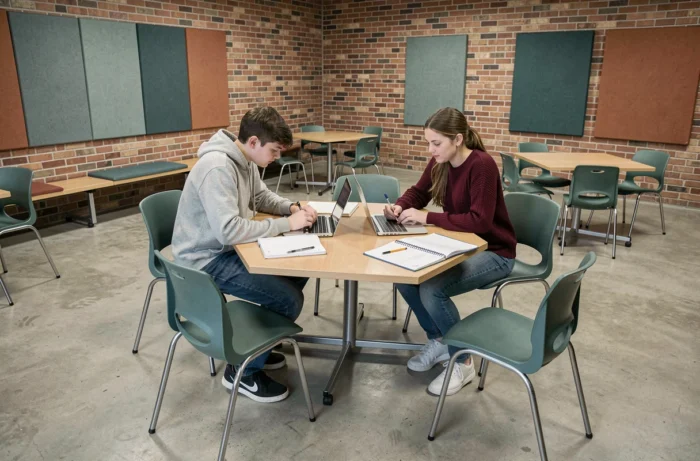
Schools are classified as ERP and are subject to fire reaction requirements for their equipment. The French classification ranges from M0 (non-combustible) to M4 (easily flammable). The materials used for seating, tabletops, and structures must meet the thresholds imposed by the regulations applicable to the type of establishment.
A laminated tabletop does not have the same fire reaction as a raw solid wood tabletop. Surface treatments, coatings, and core composition directly influence the classification. During a tender process, it is relevant to request fire classification reports rather than relying solely on the manufacturer’s declaration.
What communities often overlook
The fire classification applies to the finished product, not to raw materials taken in isolation. An assembly combining metal, wood, and plastic must be evaluated as a whole. Technical data sheets that mention the classification of each component without certification of the assembled product leave a regulatory blind spot.
Materials and durability: balancing initial cost and usage cost
The choice of materials for school furniture is based on a triangle of constraints: mechanical strength, ease of maintenance, and budget.
Polypropylene, used for seat shells, is resistant to impacts and easy to clean. Solid wood offers better structural longevity but requires more regular maintenance. Tubular steel structures, often combined with plastic seating, represent the most common compromise in primary schools and colleges.
Furniture replaced every four years costs more than durable equipment renewed half as often. Communities that consider usage cost over ten years rather than unit purchase price make substantial savings while reducing the volume of waste produced.
Maintenance in the school environment
Porous surfaces accumulate dirt and complicate disinfection. In a context where daily cleaning of classrooms is the norm, materials with smooth, non-absorbent surfaces reduce maintenance time. Rubber foot caps, often overlooked, protect floors and reduce noise, contributing to a better sound environment in the classroom.
Flexible layout and learning: what modularity changes
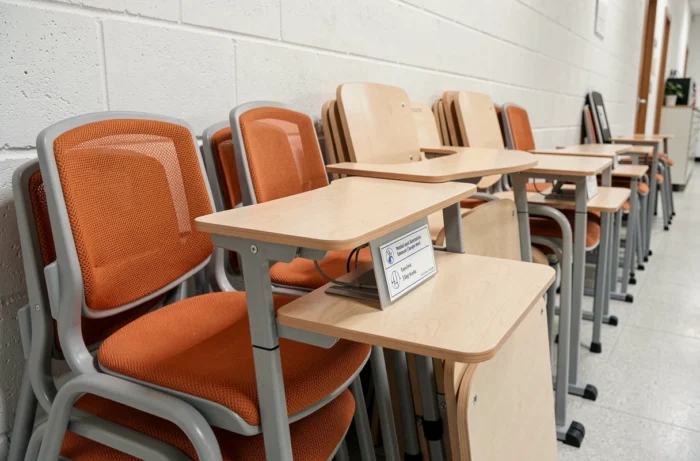
Modular furniture allows for reconfiguring the space according to the activity: individual work, group work, collective presentation. Trapezoidal tables or tables with tiltable tops facilitate these transitions without moving all the furniture.
Modularity only makes sense if the furniture remains manipulable by the students themselves. A 25 kg modular table that can only be moved by an adult will not change teaching practices. The unit weight and the presence of lockable wheels are concrete criteria to check before purchase.
School spaces that combine fixed zones and reconfigurable areas offer a greater variety of learning situations. This flexibility does not replace properly sized furniture: it complements it by allowing the arrangement to adapt to the current educational needs.
The choice of school furniture commits communities for several years. Cross-referencing the requirements of the NF EN 1729 standard with the actual heights of students, verifying the fire reaction reports of the finished product, and reasoning in terms of usage cost rather than catalog price are three levers that separate imposed equipment from equipment designed for the well-being of children.