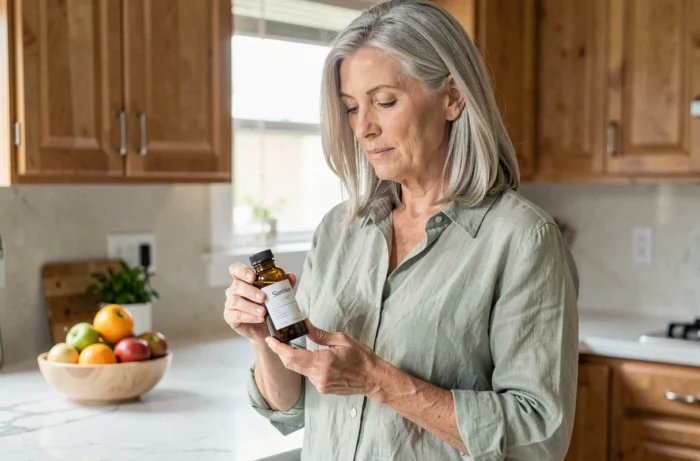
The market for dietary supplements aimed at menopausal women continues to expand, with formulas targeting hot flashes, sleep, and bone health. Positive testimonials abound on forums and parapharmacy websites. The Menopause Society reminded in 2023 that supplements and herbal remedies do not have sufficiently strong evidence to be recommended against hot flashes.
Between individual feelings and clinical data, the choice of a dietary supplement for menopause deserves careful examination.
What women’s testimonials reveal (and what they don’t say)
On review platforms and discussion groups, certain plants frequently come up: sage, black cohosh, soy isoflavones, red clover. Women often describe an improvement in hot flashes or sleep after a few weeks of taking them. These experiences heavily influence purchasing decisions.
A rarely mentioned point in these testimonials: menopause symptoms naturally fluctuate over the months. An improvement felt after starting a treatment may coincide with a spontaneous change, with no direct link to the product. The placebo effect also plays a documented role in the perception of hot flashes. Identifying what is due to the supplement and what is due to the passage of time remains very difficult without a controlled protocol.
Women looking for the best dietary supplement for menopause would benefit from cross-referencing these testimonials with the available data on each active ingredient, rather than relying solely on online reviews.

Isoflavones, black cohosh, sage: the level of evidence varies by active ingredient
Not all ingredients sold under the “menopause” label are equal, and the same plant name can cover very different preparations.
Soy isoflavones and phytoestrogens
Isoflavones are the most studied phytoestrogens. Their mechanism is based on a chemical structure similar to estradiol, allowing them to bind to estrogen receptors. Some studies show a modest effect on the frequency of hot flashes, but results vary depending on the preparation and dosage used. A standardized extract tested in a clinical trial does not guarantee that the product available in pharmacies contains the same type of extract at the same concentration.
Phytoestrogens are also not recommended for women with a history of hormone-dependent cancer, as noted by sante.fr in its recommendations.
Black cohosh
This North American plant is often cited for its effects on sleep disturbances and irritability related to menopause. Its mode of action remains debated: it does not seem to act like a classic phytoestrogen. Again, marketed preparations differ significantly from one laboratory to another. Results observed for a specific extract do not allow conclusions to be drawn about all products on the market bearing this name.
Black cohosh has been associated with rare cases of liver damage. Possible interactions with certain medications justify a medical consultation before any regular intake.
Sage and chaste tree
Sage frequently appears in positive reviews from women troubled by night sweats. The chaste tree, on the other hand, is mainly used in perimenopause for its phyto-progestogenic properties, particularly against breast tension. For these two plants, large-scale clinical studies are still lacking to establish a level of evidence comparable to that of hormone therapy.
Menopause dietary supplements: quality criteria to check
In the face of the abundance of formulas, certain guidelines can help sort products more rigorously:
- The concentration of the main active ingredient must be clearly indicated on the packaging. A product that only mentions “soy extract” without specifying the isoflavone content does not allow for comparison with the dosages studied in clinical research.
- The form of the extract is as important as the plant itself. A titrated and standardized extract offers better reproducibility than raw plant powder.
- The presence of labels or third-party controls (contaminant analysis, compliance with European standards) provides a minimum guarantee of manufacturing quality.
- “All-in-one” formulas that combine five or six active ingredients at low doses risk not providing any ingredient in sufficient quantity to produce an effect.
A dietary supplement remains a health product subject to less strict regulation than that of medications. No supplement can legally claim to treat or cure menopause symptoms.
Phytoestrogens and medical history: an underestimated precaution
Discussions among women about dietary supplements for menopause rarely address the issue of contraindications. Phytoestrogens, due to their action on hormonal receptors, pose a specific problem for women with a history of hormone-dependent cancers (breast, endometrium). Sante.fr explicitly recommends avoiding these substances in this context.
Black cohosh, although not classified among phytoestrogens in the strict sense, can interact with ongoing treatments. Consulting a doctor before starting a treatment remains the only reliable precaution, even for a product sold without a prescription.

Vitamins D and E, calcium, or omega-3s are sometimes included in menopause formulas to target bone health or skin dryness. These nutrients address real needs related to hormonal aging, but their presence in a “menopause” supplement does not mean they will act on hot flashes or mood disorders. Each symptom calls for a different active ingredient, and no single formula covers the entire clinical picture of menopause.
The choice of a dietary supplement for menopause should be based on the precise identification of the primary symptom, verification of the dosage and quality of the extract, and medical advice tailored to personal history. Testimonials from other women serve as a starting point, not proof of efficacy.