
A family board game relies on a precise balance: rules that can be grasped in a few minutes, a game duration compatible with daily life, and a level of interaction that keeps the attention of adults as well as children.
The French board game market has doubled between 2013 and 2024, increasing from around 300 million to nearly 600 million euros in revenue, and the family segment remains dominant in volume. Choosing the right title for a family evening requires understanding a few basic mechanics before being tempted by a box.
Game Duration and Mental Load: The Real Selection Filter
Most board game selections list titles without explaining why some work better than others in a family context. The determining criterion is neither the theme nor the material, but the actual duration of a game, including rule explanation.
Since 2024, the best-selling family games in France are those whose games last between 15 and 30 minutes. This time constraint is not trivial: it corresponds to the window available between homework, bath time, and bedtime. Publishers have integrated this into their design process, favoring simultaneous turns and streamlined rules to reduce downtime.
A complete catalog of family references can be consulted at https://www.vosjeux.fr/, with filters by age and game duration.
The mental load per turn is as important as the total duration. A game where each player must evaluate five different options on their turn slows down the game and causes younger players to lose interest. Titles that work best in family settings limit choices to two or three possible actions per turn while maintaining enough depth so that adults do not get bored.
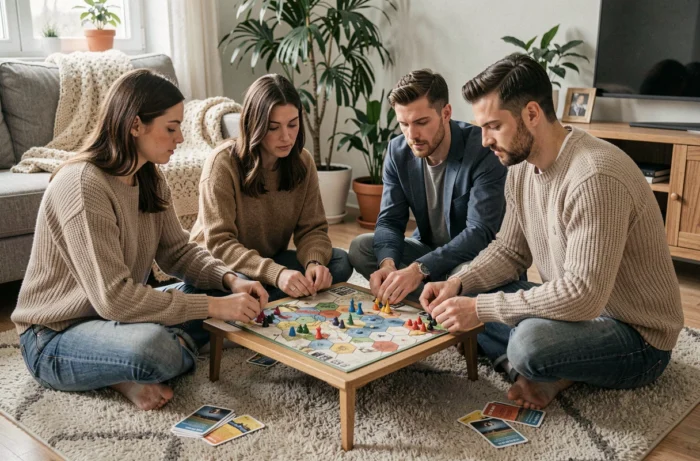
Board Game Mechanics Suitable for All Ages
Understanding the main families of mechanics allows for choosing a game suited to the profile of the players. Three categories dominate the family segment.
Collectible Card Games and Risk-Taking
The principle: accumulate cards to score points while avoiding an elimination condition (duplicates, exceeding a threshold). Flip 7, which is among the bestsellers in France, illustrates this mechanic. Each card has a unique value, and the higher the number, the more frequent the card is in the draw pile. The probability calculation remains intuitive, accessible from age 7 or 8, but risk management keeps the tension for experienced players.
Party and Communication Games
These titles rely on verbal or gestural interaction rather than pure strategy. Crack List or Crack Rimes require finding words under time constraints, generating laughter without favoring the more analytical players. The absence of a board and complex counting speeds up setup, an asset when the gaming window is short.
Accessible Strategy Board Games
The board adds a spatial dimension that appeals to older children. Family strategy titles keep games under 45 minutes by limiting the number of resources to manage. Harmonies, for example, requires building a landscape by placing colored tiles, with placement choices that remain clear without being simplistic.
Two-Player Games: A Rapidly Growing Segment
The “family evening” top lists often overlook a common configuration: the duo. Since 2023, two-player games have seen marked growth, driven by couples and households with a single child of playing age.
A good two-player game relies on direct interaction between players, not on a solitary mechanic played in parallel. Board duels (territory confrontations, point races) and asymmetrical card games (each player has a different deck or powers) offer the best replayability in this format.
Here are some criteria to identify a lasting two-player game:
- An initial asymmetry (different roles, cards, or objectives) that refreshes each game and prevents repetitive strategies.
- A game duration of less than 30 minutes, allowing for two rounds in the same evening without fatigue.
- A high level of interaction in each turn (blocking, anticipating opponents’ moves), rather than a simple accumulation of points in parallel.
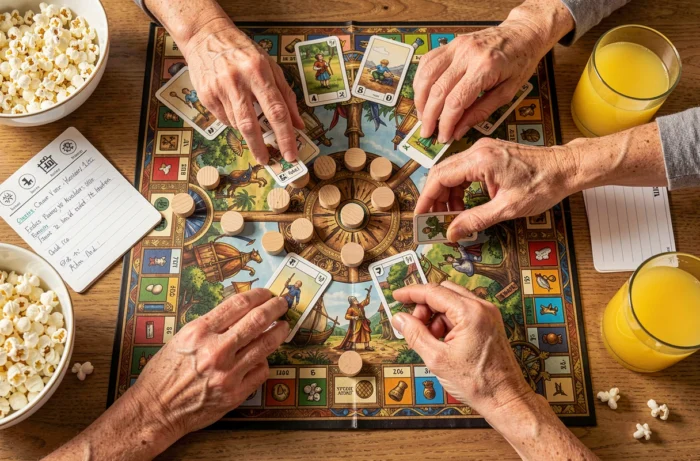
Building a Balanced Family Game Library
Owning ten games of the same type leads to boredom. A family game library benefits from covering three complementary registers: a quick card game for weekday evenings, a party game for meals with guests, and a strategic board game for rainy weekends.
Varying mechanics prevents the same player profile from winning consistently. A child who is not comfortable with calculations may excel in a verbal party game, while a competitive adult will find satisfaction in a spatial placement game.
The budget also deserves consideration. Card games generally cost under 15 euros, while board games with elaborate materials go higher. Starting with two or three titles of different formats, then observing which ones come to the table most often, remains the most reliable method before expanding the collection.
- For short evenings: a card game with instant rules (like Flip 7 or Skyjo), completed in a quarter of an hour.
- For evenings with guests: a party game that accommodates six players or more, without strategic prerequisites.
- For family afternoons: an accessible board game with a duration of 30 to 45 minutes and a strong visual component.
The French board game market continues to grow, with an increase of around 4% in 2025 compared to the previous year. This dynamic fuels a steady stream of new releases, but the titles that remain on family tables year after year all share the same trait: clear rules that do not hinder tactical depth.