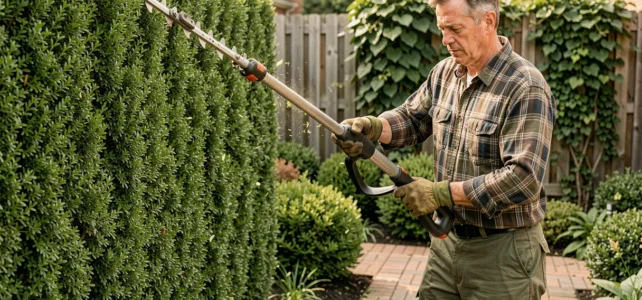
Trimming the top of a three-meter hedge from a ladder, with a heavy tool held at arm’s length, remains one of the most accident-prone situations in the garden. The telescopic hedge trimmer solves this problem by keeping your feet on the ground. However, you still need to choose the right model and use it correctly, as not all extendable handles are created equal and the trimming period itself is regulated by law.
Hedge Trimming Period: A Legal Constraint to Know Before Any Purchase
Before comparing models, ask yourself a simple question: when are you allowed to trim? In France, trimming is prohibited from March 16 to July 31 for individuals, in order to protect birds during their nesting period. Farmers are subject to a ban from April 1 to July 31.
This regulation directly affects your work schedule. It reduces the intensive use window to two periods: the end of summer (August-September) and the end of winter (February-early March). A battery-operated telescopic hedge trimmer with limited autonomy may suffice for two annual passes, while a corded model will be suitable if your hedges are long and you concentrate all the work over a weekend.
Buying guides rarely mention this schedule. Yet it determines the level of autonomy and power you actually need.
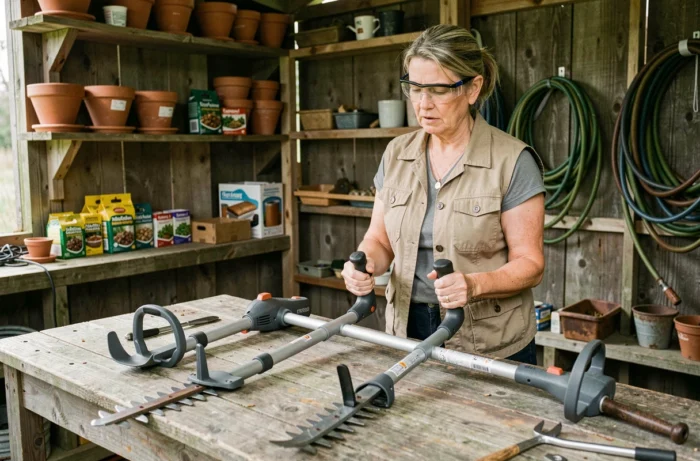
Adjustable Cutting Head: The Criterion That Distinguishes a Good Telescopic Hedge Trimmer from a Bad One
The length of the handle often grabs all the attention. This is a mistake. Have you ever noticed that a hedge doesn’t just have a flat top? It also has sides, angles, and sometimes a rounded shape. The adjustable cutting head determines the actual versatility of the tool.
On entry-level models, the angle of the blade is adjusted manually by loosening a bolt. The result: time is wasted, work is interrupted, and eventually, the angle is no longer changed. Mid-range models offer a quick ratchet system, often with five or seven positions. This is the minimum to alternate between top trimming (blade nearly horizontal) and trimming the high sides (blade tilted at about 90 degrees).
A detailed comparison by type of motorization and head is available at taille-haie-telescopique.com, allowing you to visualize the design differences between brands.
Weight and Weight Distribution
Working with arms raised using an unbalanced tool tires the shoulders in just a few minutes. What matters is not just the total weight, but where the center of gravity is located. A motor placed at the lower part of the handle (near the grip) significantly relieves the effort, even if the tool weighs a bit more on the scale.
Always test the tool in the raised position before purchasing. Some specialized stores allow this. If you order online, check that the return policy allows for a trial.
Battery, Corded, or Gas: Which Motor for a Pole Hedge Trimmer
The hedge trimmer market has significantly shifted towards battery models in recent years. For telescopic use, this trend has a particular significance.
- Lithium-ion battery: total freedom of movement, no cord to step over or extension to manage at height. The autonomy varies according to the battery capacity. A well-sized model covers the complete trimming of a medium-sized hedge on a single charge. Prefer a battery compatible with other tools from the same brand to amortize the investment.
- Corded (electric): constant power, generally lighter weight (no built-in battery), lower purchase price. The constraint is the cable. On a pole several meters long, the cord can get caught, pull on the tool, and create a risk of accidental cuts. Reserve this choice for hedges close to an outdoor outlet.
- Gas: high power, suitable for thick branches and very long runs. In return, the gas engine adds weight to the whole and generates significant vibrations. On a telescopic handle, these vibrations are transmitted along the entire length. Prolonged use becomes uncomfortable, especially for an individual.
For the majority of gardens, a battery model offers the best compromise between comfort and performance for a telescopic hedge trimmer.
Blade and Cutting Capacity: Adapting the Tool to the Thickness of Your Branches
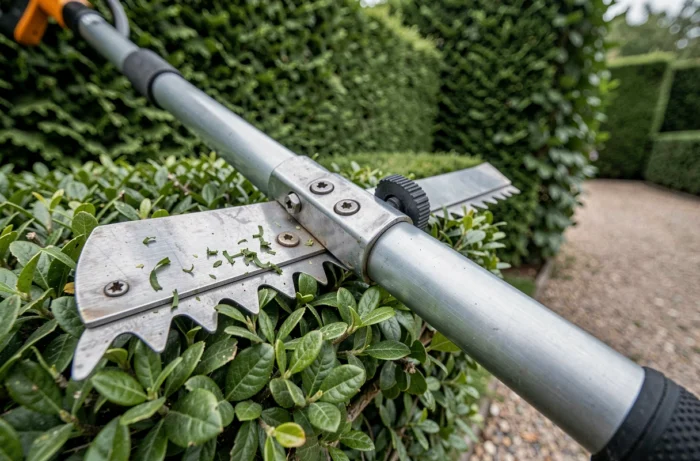
Why is this criterion often underestimated? Because the spacing of the blade teeth is not always prominently displayed on the packaging. Yet it determines the maximum diameter of branches that the tool can cut cleanly.
A wide spacing is suitable for country hedges with thick twigs (privet, hornbeam). A narrow spacing provides a cleaner cut on fine foliage (thuja, laurel). Choosing the wrong blade damages the hedge and prematurely wears out the mechanism.
Blade Length on a Telescopic Model
A long blade covers more surface area with each pass, reducing work time. However, it increases the weight at the end of the pole and makes the tool more difficult to maneuver in corners. For domestic use, a medium-sized blade is the best compromise between efficiency and maneuverability.
Safety Practices and Maintenance After Each Trim
Working at height with a moving blade requires some reflexes. Wear protective glasses: falling plant debris into the eyes is common when cutting above you. Thick gloves protect against vibrations and projections.
After each session, clean the blade with a damp cloth to remove sap. Dried sap corrodes the teeth and reduces cutting quality from the next session onward. A light oiling of the blades with an appropriate product extends their lifespan.
Store the pole tool folded in a dry place. The battery, if you are using one, should ideally be kept between 40 and 80% charge during the inactive winter months. This preserves capacity over the long term.
The telescopic hedge trimmer remains a specialized tool, designed for a specific need: to reach what your arms cannot. By focusing your choice on the quality of the adjustable head, the type of motorization suitable for your garden, and the blade spacing corresponding to your hedges, you avoid returns to the store and frustrating trimming sessions.