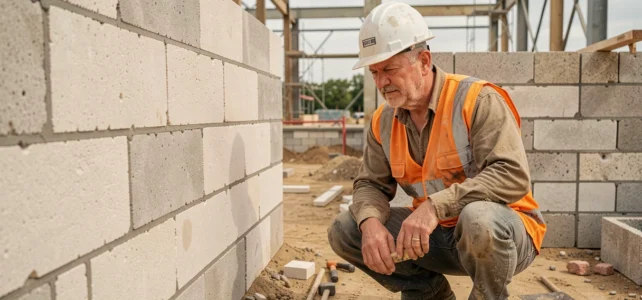
Insulating concrete forms (ICF) made of expanded polystyrene and traditional concrete blocks do not fall into the same price category per square meter of finished wall. Comparing the two requires considering the total cost, including insulation, rather than just the unit price of the block. Since the tightening of carbon thresholds under RE2020 on January 1, 2025, this comparison has taken on a regulatory dimension that significantly alters the financial equation.
Thermal resistance of the finished wall: the true price determinant
A 20 cm concrete block wall has a negligible thermal resistance on its own. To meet RE2020 requirements, it must be supplemented with added insulation, most often mineral wool or expanded polystyrene from the outside or inside. The cost of this added insulation represents a significant portion of the wall budget.
The insulating formwork made of polystyrene (hollow blocks of EPS filled with poured concrete) inherently integrates two layers of insulation on either side of the load-bearing core. The ICF wall comes out of the formwork already insulated, without the need for additional intervention from a drywall installer or a facade worker installing an external insulation system. We observe that this integration shortens the construction schedule by several weeks for a 100 m² habitable house.
When considering the complete wall (structure + insulation + interior finishes), the cost gap between the two solutions narrows considerably compared to the simple price of the block. Anyone comparing the price of a polystyrene house construction to that of concrete blocks without including the added insulation skews the comparison from the outset.
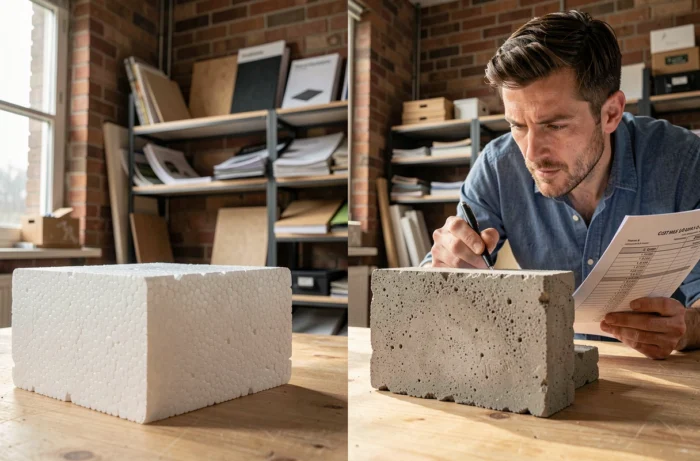
RE2020 carbon thresholds and regulatory cost increase for concrete blocks
Since January 1, 2025, the Ic construction threshold for new individual homes has dropped from about 640 to 530 kg CO₂e/m² of floor area, representing a decrease of approximately 15 to 17%. This contraction directly penalizes the classic configurations of concrete blocks + expanded polystyrene as added insulation.
Several analyses show that concrete block walls combined with EPS, compliant in 2022, now exceed the new thresholds without resorting to low-carbon concrete or bio-based insulations. Switching to these alternative materials incurs a specific cost increase, independent of the initial structural choice.
The average RE2020 cost increase reaches 5 to 10% of construction costs compared to the previous RT2012, according to cross-feedback from the FFB and engineering firms. This cost increase focuses on the increased thickness of insulation, enhanced treatment of thermal bridges, and the use of low-carbon materials.
Concrete impact on the concrete block budget
To remain below the Ic construction threshold, a concrete block project must now incorporate at least one of these adjustments:
- Substituting EPS with a bio-based insulation (wood fiber, cellulose wadding), whose installed price per square meter significantly exceeds that of polystyrene
- Using low-carbon concrete for filling the blocks or foundations, which requires specific sourcing and incurs material costs
- Compensating with other items (triple-glazed windows, high-efficiency dual-flow ventilation), which increase the overall budget
The ICF formwork in polystyrene does not escape the carbon constraint of EPS itself, but the volume of concrete used in the core is lower than that of a traditional concrete block wall, which partially mitigates the Ic balance.
Implementation cost and labor: concrete block versus ICF formwork
The concrete block remains the material best mastered by French masons. The availability of qualified labor for concrete blocks is a real economic advantage: installation rates are competitive, there are many companies, and negotiating quotes is easier.
The ICF formwork requires specific training. The assembly of the blocks is quick (interlocking without mortar), but pouring concrete into the formwork requires mastery of vibration and filling rhythm to avoid blowouts. We recommend verifying that the chosen company has completed at least three ICF projects before signing.
The time savings on the structural work partially offset the higher hourly cost of a team trained in insulating formwork. On a well-organized site, the shell is reached more quickly, reducing equipment rental costs and weather-related delays.
Often overlooked items in the comparison
- Interior finishes: the ICF wall directly receives a coating or facing, whereas the concrete block requires an insulating layer followed by a plasterboard
- Air tightness: the ICF formwork, monolithic after pouring, naturally limits infiltration, reducing the cost of the final air tightness test
- Foundations: both systems rely on comparable concrete footings, so this item does not create a significant difference
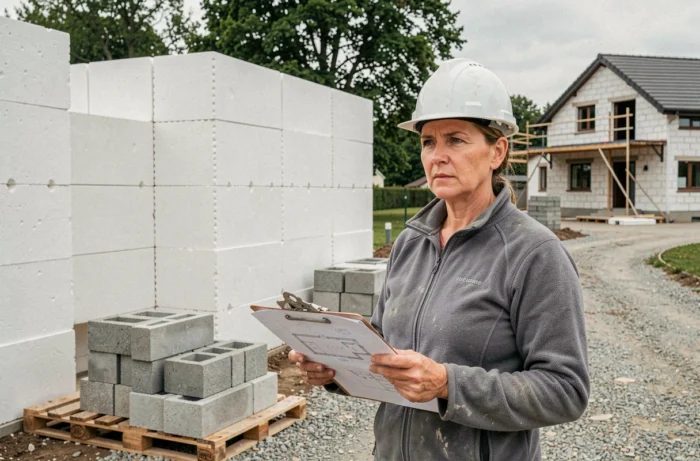
Economic arbitration based on the project: when ICF polystyrene becomes cost-effective
In a compact single-story house with a rectangular plan, concrete blocks often remain the cheapest solution in terms of finished wall cost, mainly due to the low price of the block and competition among masons. The gap narrows as the area exceeds 120 m² or the geometry becomes more complex (stories, projections, multiple angles).
The ICF formwork becomes competitive for multi-story houses where the treatment of thermal bridges in concrete blocks increases insulation costs. The floor-wall junctions, classic weak points of concrete blocks, are naturally addressed in a continuous ICF system.
The choice also depends on the climatic zone. In cold climates (zones H1a, H1b), the required insulation thickness on a concrete block wall pushes the budget up, mechanically bringing the two solutions closer. In Mediterranean areas, where insulation requirements are lower, concrete blocks maintain a more pronounced price advantage.
The final arbitration does not hinge on the price per square meter of wall, but on the total cost per habitable square meter, including finishes and RE2020 compliance. Requesting comparative quotes for these two systems for the same plan remains the only reliable method to decide, as the differences vary significantly by region and the availability of companies trained in insulating formwork.