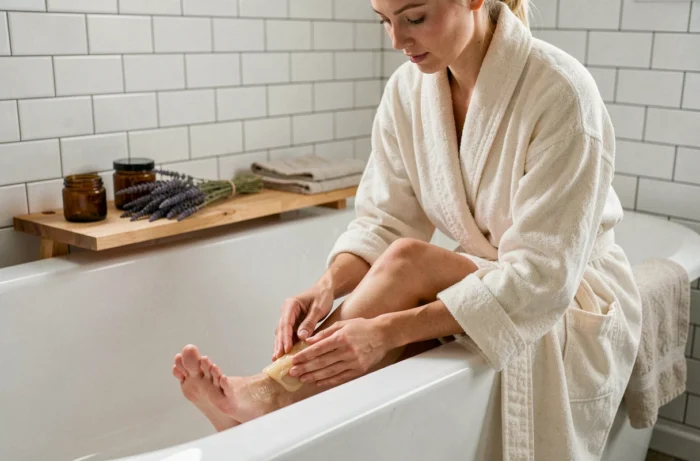
In France, natural cosmetics and conventional cosmetics are subject to the same regulatory framework, Regulation (EC) No. 1223/2009, which mandates a safety assessment before any market launch. However, the term “natural” does not benefit from a uniform legal definition in Europe. This gap between consumer perception and regulatory reality deserves attention, especially when it comes to products applied to an area as stressed as the feet.
European Cosmetic Regulation and Foot Care: What “Natural” Really Means
A foot care product labeled “natural” undergoes the same safety checks as a cream formulated with synthetic ingredients. Toxicological assessment, stability testing, and declaration of allergenic substances above certain thresholds: all of this falls under the same European regulation, regardless of the origin of the ingredients.
The difference lies elsewhere. The word “natural” is not governed by any uniform legal definition in Europe. A manufacturer can place it on a package without guaranteeing a fully plant-based composition or the absence of controversial additives. To navigate this, one must read the INCI list and check if a third-party label (Cosmos, Natrue, Ecocert) actually certifies the formulation.
To explore ranges of foot care products formulated from natural origin ingredients dedicated to foot comfort, a useful resource is: https://www.calcea.fr/.
Furthermore, European regulation will strengthen the framework for ecological claims on cosmetic products. Distinguishing the natural origin of ingredients from the overall environmental impact of the product will become a stricter obligation for brands.
Essential Oils on Foot Skin: A Use That Requires Real Precautions
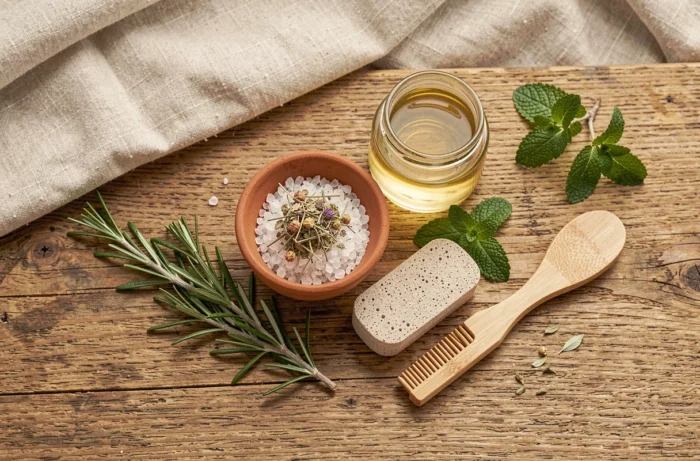
Natural foot care advice almost systematically mentions essential oils for a relaxing foot bath or a foot massage. What these guides often overlook is the potential irritating and sensitizing effects of these plant concentrates.
Some essential oils contain allergenic compounds regulated by Annex III of the European Cosmetics Regulation. These substances must be declared on the label above certain thresholds. The topical use of essential oils requires significant dilution, in a vegetable oil or suitable excipient, and should never be applied pure.
- Asthmatic or allergic individuals should test any essential oil on a small area of skin before broader use, and ideally consult a healthcare professional.
- Pregnant or breastfeeding women and young children are among the populations for whom the use of essential oils is discouraged or subject to strict restrictions.
- Storage also matters: an oxidized essential oil (exposed to light or heat) significantly increases its irritating potential.
A natural foot product that incorporates essential oils is not automatically gentler than a conventional treatment. Skin tolerance depends on the complete formulation, not the natural character of an isolated ingredient.
Dry Skin and Calluses on Feet: Urea, an Often-Underestimated Natural Active Ingredient
The feet endure mechanical stresses that the face or hands do not experience. Body weight, friction from shoes, prolonged standing: all of this thickens the stratum corneum and dries out the plantar skin faster than elsewhere.
To address this specific need, urea is among the most documented actives in foot care. Naturally present in human skin, it acts differently depending on its concentration in the cream. At low concentration, it functions as a humectant and maintains hydration. At higher concentrations, it helps to exfoliate the accumulated layers of callus, aiding in achieving softer skin.
This point illustrates a reality often overlooked in discussions about natural care: the effectiveness of a product depends on the targeted skin need, not the natural character of the formula. Pure shea butter may be suitable for moderately dry skin. For cracked heels or pronounced plantar hyperkeratosis, a concentrated urea cream will likely be more appropriate, even if it also contains synthetic components.

Natural Foot Care Routine: What Matters Daily
Rather than a list of universal gestures, what makes a difference in a foot care routine is consistency and the choice of products based on one’s own skin.
Daily washing with a mild soap remains the foundation. The space between the toes deserves particular attention: it is the area most prone to fungal infections, and incomplete drying is enough to create a favorable environment for mycoses. This simple gesture is more decisive than any weekly foot bath.
Hydration, then, should be targeted. A rich cream applied in the evening to the heels and the arch of the foot, followed by wearing cotton socks, allows for more effective penetration of actives overnight. For the rest of the foot, a lighter treatment is often sufficient.
- Mechanical exfoliation (pumice stone, rasp) should remain gentle and spaced out to avoid stimulating callus production in response.
- Toenails should be cut straight, without rounding the corners, to limit the risk of ingrown nails.
- The choice of shoes plays a direct role in foot health: an inappropriate size or non-breathable material will negate the benefits of any care routine.
Natural Raw Materials and Climate
A rarely addressed aspect concerns sourcing. Climate change affects the availability of certain natural origin cosmetic raw materials. Field reports vary on this point depending on the sectors, but securing supplies is becoming a concrete issue for natural care manufacturers. Choosing a natural product also involves looking into the traceability of its ingredients.
Caring for your feet with natural products remains a relevant approach, provided that “natural” is not confused with “risk-free.” Reading labels, checking certifications, adapting care to the actual state of one’s skin: these are the reflexes that make a difference, far more than the marketing of a green package.