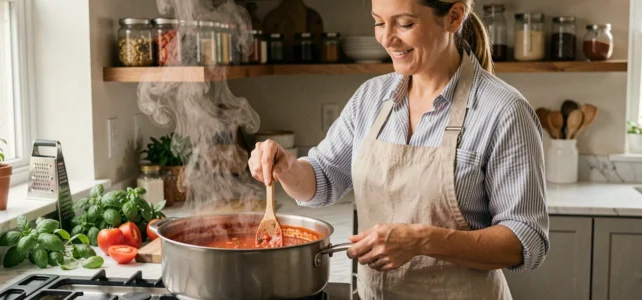
Preparing easy and delicious recipes every night of the week involves solving a multi-variable equation: available time, grocery budget, the differing tastes of children and adults, and the desire (or lack thereof) to spend time in the kitchen. Rather than stacking lists of dishes, this article compares the major categories of family meals based on these concrete criteria to identify those that truly deliver on their promises in everyday life.
Preparation time and cost per serving: comparison of family meals
Family recipes fall into major culinary families whose constraints vary greatly. The table below contrasts five common categories across two axes that determine their viability during the week: the actual time spent in the kitchen and the average budget per person.
| Dish Category | Active Preparation Time | Relative Cost per Serving | Children’s Acceptance |
|---|---|---|---|
| Gratins (pasta, vegetables, potatoes) | 10-15 min + oven cooking | Low | Very high |
| Quiches and savory tarts | 15-20 min + oven cooking | Low to moderate | High |
| Stews (blanquette, chili, dahl) | 15-20 min + passive simmering | Low | Variable depending on spices |
| Stir-fries and quick sautés (chicken, vegetables) | 15-25 min | Moderate | High if sweet sauce |
| Composed meal salads | 15-20 min | Moderate to high | Low for under 8s |
Gratin and savory tart dominate the active time/satisfaction ratio. The time spent standing in front of the counter rarely exceeds fifteen minutes, with the oven doing the rest. Stews offer an even lower cost per serving (lentils, legumes), but their acceptance by children heavily depends on seasoning.
Resources like https://www.papillesheureuses.fr/ allow you to find family recipes organized by dish type and difficulty level, which helps navigate between these categories.

Grocery budget for a week of family meals: items to negotiate
Several culinary media now structure their family menus around explicit price constraints, with dinner plans for four people calibrated to not exceed 70 euros per week. This approach relies on so-called “smart” ingredients: legumes (lentils, chickpeas), seasonal vegetables bought in bulk, pasta, rice, eggs, and grated cheese.
The animal protein category remains the one that tips the budget. A whole roasted chicken on Sunday, turned into salad on Monday and leftover gratin on Tuesday, costs significantly less than three distinct meat-based dishes.
High-yield ingredients for everyday recipes
- Red lentils cook in less than fifteen minutes without soaking and can be added to a dahl, soup, or vegetarian gratin, for a negligible cost per serving
- Zucchini can be prepared in almost any way (gratin, stir-fry, quiche, soup) and remain among the cheapest vegetables in season
- Grated cheese transforms a basic pasta or vegetable dish into a meal that children ask for again, and a small amount is enough for gratin
On the other hand, composed meal salads with avocado, smoked salmon, or mozzarella drive up the cost. They are better suited for the weekend or when the weekly budget allows.
Family batch cooking: planning five dinners in one session
Batch cooking (group meal preparation) is becoming popular among families who lack time during the week. Even home batch cooking services are emerging to ensure healthy meals throughout the week. The principle is simple: one cooking session on Sunday prepares the bases for four to five dinners.
This method works particularly well with the categories that emerged from the previous comparison. A chicken pasta gratin and a vegetable quiche can be prepared in parallel while a lentil dahl simmers on the stove.
Typical organization of a batch cooking session
Start with long cooking items (legumes, brown rice) that cook on their own. Meanwhile, prepare the mixtures for quiche or gratin. Finish with cutting raw vegetables that will be used for quick stir-fries in the following days.
Four meals prepared in one hour is the goal set by several recently published express batch cooking plans. The time savings during the week are real: it’s enough to reheat or bake a dish that has already been assembled.

Screens at the table and family meals: a constraint rarely mentioned in recipes
Culinary content discusses ingredients and cooking times but ignores a factor that directly affects the quality of family meals. According to an article from EuroLuminant published in August 2026, about 35% of parents admit to being distracted by their phones during dinner. Among 18-35 year-olds, a significant portion watches video content or checks social media while eating.
This observation has a direct link to recipe choices. A dish that is shared (gratin placed in the center of the table, tart cut together) creates a moment of conviviality that is harder to ignore than an individual plate consumed in silence. Shared dishes encourage interaction around the table, restoring the family dinner to its primary function.
Choosing delicious recipes for the family is not just about finding the right time-budget ratio. The form of the meal (shared dish, table service, children’s participation in preparation) weighs as much as the content of the plate. A zucchini gratin that brings everyone together around the dish fulfills its role better than an elaborate menu consumed in front of a screen.