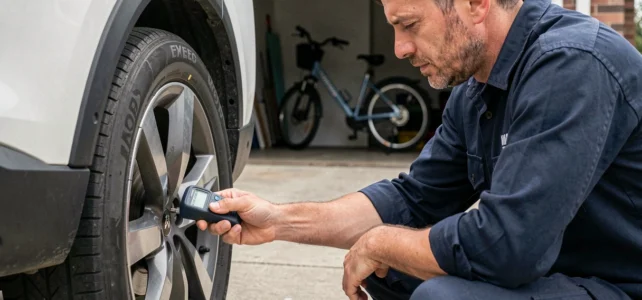
The Peugeot 2008 uses two distinct approaches to monitor tire pressure, depending on whether it is the first or second generation. Before initiating any reset, identifying the type of embedded TPMS system determines the procedure, the menu to find, and the errors to avoid. This guide details the concrete steps for each case, the conditions to meet, and the pitfalls that keep the orange warning light on the dashboard.
Indirect TPMS or direct sensors: what changes according to the generation of Peugeot 2008
Not all Peugeot 2008 models manage pressure in the same way. The table below summarizes the differences between the two generations.
| Criterion | 2008 I (2013-2019) | 2008 II (2019-present) |
|---|---|---|
| TPMS Type | Indirect (ABS sensors) | Indirect (ABS sensors) or direct depending on the trim |
| Access to reset | Physical button “SET TPMS” near the gear lever or under the dashboard | Touchscreen menu: Driving / Driving assistance / Under-inflation initialization |
| Engine contact required | Yes, contact on without starting | Yes, contact on without starting |
| Screen confirmation | Flashing then fixed warning light | Validation message on the central screen |
On the first generation, the manipulation remains physical: a sustained press on the dedicated button is sufficient. On the second, the procedure is entirely through the touchscreen, and the physical button has disappeared. Many tutorials still mix the two approaches, causing confusion.
Before any operation, it is useful to know how to reset the tire pressure of the Peugeot 2008 based on the exact model year, as a menu or button error wastes time without solving the problem.
Tire pressure reset Peugeot 2008: step-by-step procedure
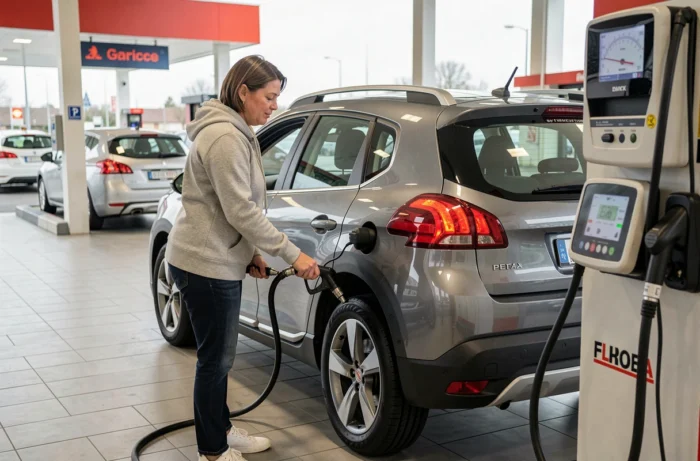
The sequence varies slightly depending on the generation, but the principle remains the same: inform the TPMS that the current pressures constitute the new reference.
On Peugeot 2008 I (2013-2019)
- Inflate all four tires to the values indicated on the label affixed in the driver’s door frame (around 2.2 bars in normal use)
- Take your place in the driver’s seat, turn on the ignition without starting the engine
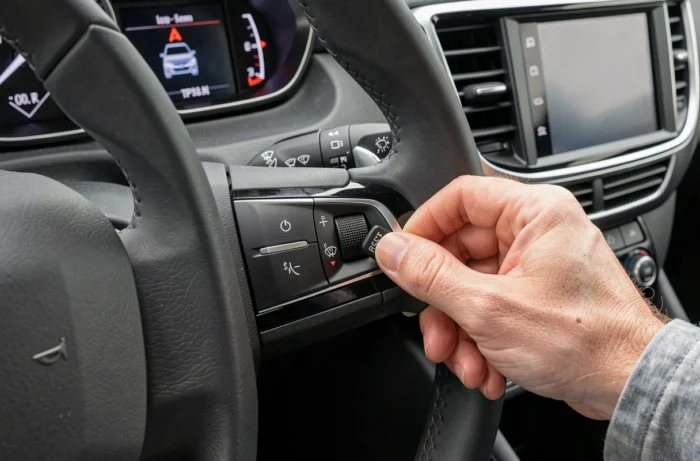
- Locate the “SET TPMS” button (located depending on the versions near the gear lever or under the steering wheel on the left), then hold the press until the pressure warning light flashes
- Release the button. The light will fix, then turn off after a few kilometers of driving
On Peugeot 2008 II (2019-present)
- Inflate all four tires to the pressure recommended by the manufacturer
- Turn on the ignition, access the central touchscreen
- Navigate to the “Driving” menu (or “Driving assistance” if the interface is in English), then select “Under-inflation initialization”
- Confirm the reset when prompted by the system. A validation message will appear on the screen
- Drive for a few minutes for the system to record the new reference values
In both cases, the warning light may take several kilometers to turn off completely. This is normal behavior for the system.
Cold tires before TPMS reset: a condition often overlooked
The reset must be performed on cold tires, after several hours of vehicle immobilization. The reason is physical: a warm tire shows a pressure higher than its actual resting pressure. Initiating the reset in this state skews the reference level recorded by the system.
The consequences are concrete. In winter, in the morning, the pressure drops with the temperature. If the reference was taken with warm tires, the system detects a fictitious under-inflation and triggers unnecessary alerts. In summer, conversely, the alert threshold is artificially raised, which can mask a real under-inflation problem.
To ensure the reliability of the procedure, inflating and resetting in the morning before hitting the road, or after at least three hours of parking in the shade, remains the safest method.
Tire pressure warning light on Peugeot 2008 remains on after reset: technical causes
The orange warning light persists despite a correct reset in several specific situations. The most common is also the simplest: the pressure has not been checked on all four wheels with a gauge. Many drivers reinflate only one tire after an alert, then initiate the reset. The system then takes as reference a heterogeneous set, and the light comes back on at the next discrepancy.
Another classic cause: a slow leak. A nail embedded in the tread, a porous valve, or a slightly warped rim can cause a loss of a few tenths of a bar per week. The reset temporarily masks the problem, but the alert returns in a few days.
If the light persists after properly inflating all four tires when cold and restarting the reset procedure, a visit to the workshop is necessary. On versions equipped with direct TPMS sensors (mounted inside each wheel), the sensor battery may be near the end of its life. Its lifespan depends on usage, and replacement requires tire dismounting.
Common mistakes that skew the TPMS system of the Peugeot 2008
Three scenarios frequently appear on forums dedicated to the Peugeot 2008 and deserve to be detailed.
The first concerns wheel changes without recalibration. Switching from winter wheels to summer wheels (or vice versa) without restarting the reset leaves the system working with outdated data. The rolling circumference changes, and the indirect TPMS interprets the difference as a pressure anomaly.
The second trap affects drivers who use a foot pump or a poorly calibrated automatic inflation station. An imprecise gauge by a few tenths of a bar is enough to create a gap between the actual pressure and what the system considers normal. Checking the pressure with an independent gauge before initiating the reset eliminates this source of error.
The third case, rarer, occurs after a software update of the vehicle. Some updates to the multimedia system can reset the TPMS settings without warning. If the light comes on for no apparent reason after a visit to the dealership, simply restarting the reset procedure is sufficient in most cases.
A reliable TPMS system relies on accurate starting data. Inflating when cold, checking all four wheels, using a reliable gauge, and then initiating the reset in the correct menu: these four steps, in this order, resolve almost all issues with persistent warning lights on the Peugeot 2008.