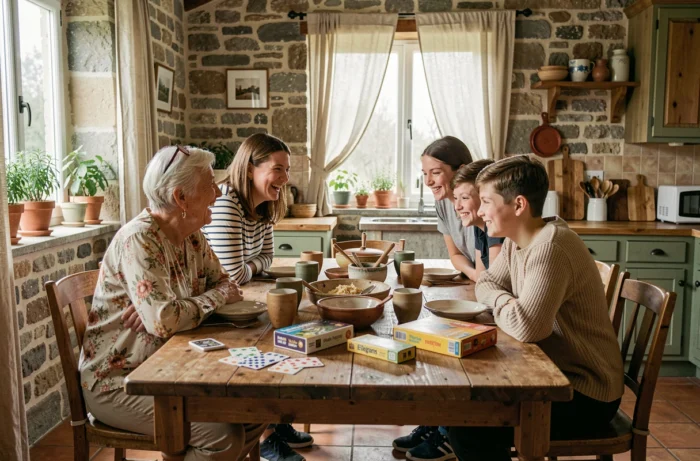
Strengthening family ties involves understanding what weakens them. Recent research shows that the most underestimated factor is not the lack of time spent together, but the quality of the context in which interactions take place. What indicators distinguish a family whose ties are strengthening from a family that is gradually drifting apart?
Screens and Family Ties: What Longitudinal Research Says
The debate about the impact of screens on family life often relies on impressions. A longitudinal study conducted over ten years by Nobakht et al., published in the Journal of Youth and Adolescence in 2026, provides more nuanced data. Teenagers who use social media a lot do not, on average, have worse family relationships than others.
The result may be surprising. However, the same researchers specify that the context of use weighs more than the time spent online. A teenager who checks their phone during meals or at bedtime deteriorates the quality of family interaction. The same teenager connected at other times of the day does not produce this effect.
The recommendation that follows is clear: protect a few non-negotiable “high points” (shared meals, evening conversations, bedtime rituals) rather than trying to reduce the overall volume of screen time. For families with growing children, it is useful to access www.la-revue-des-seniors.com to explore resources on intergenerational dynamics.
| Factor | Effect on Family Ties | Source |
|---|---|---|
| Total time on social media | No measured negative correlation | Nobakht et al., 2026 |
| Use during meals or rituals | Deterioration of relational quality | Nobakht et al., 2026 |
| Protection of “high points” without screens | Maintenance or strengthening of ties | Nobakht et al., 2026 |

Regular Family Rituals: Guidelines for Parents and Children
The word “ritual” can evoke something rigid. In the family context, it simply refers to a recurring moment whose form is predictable. A shared meal every evening, a walk on Sundays, a weekly reading night: the regularity of the ritual matters more than its content.
Families that maintain at least one daily ritual and one weekly ritual create a framework where communication occurs naturally. Children, especially younger ones, need these markers to feel emotionally secure. Teenagers, even if they contest them, find an anchor in them.
What Distinguishes an Effective Ritual from a Passive Habit
Watching television together every evening is a habit. It is not a ritual in the relational sense. The difference lies in the possibility of verbal and emotional exchange during the activity.
- A meal without screens where everyone shares a moment from their day creates more connection than an hour of a movie shared in silence
- A shared manual activity (cooking, gardening, DIY) generates spontaneous micro-conversations that children remember long-term
- Reading aloud with younger ones, even for ten minutes each evening, establishes a moment of exclusive attention between parents and child
The common point of these rituals: they involve mutual attention without digital distraction.
Family Communication: Moments When It Fails
Most articles on family communication prescribe listening more and speaking kindly. These tips remain vague. What concretely weakens family communication are identifiable situations.
The first is the overlap of activities. When a parent responds to a child while checking a work message, the child perceives that the exchange has no value. Conversely, a few minutes of full attention are worth more than an hour of distracted presence.
The second is the avoidance of difficult topics. Siblings growing up in an environment where disagreements are never verbalized develop avoidance strategies that they reproduce in adulthood. Naming a conflict without aggression, even briefly, strengthens trust among family members.
Adapting Communication to Children’s Ages
With a child under six years old, the main channel remains play and physical interaction (hugs, shared physical activities). Abstract conversation has not yet taken hold.
With a child between six and twelve years old, discussions work better when they are anchored in a concrete activity. Asking a question during a walk or while cooking yields richer responses than a “how was your day?” posed face-to-face.
With a teenager, respecting their personal space conditions their relational availability. Parents who accept silences without interpreting them as rejection maintain a stronger bond over time.

Intergenerational Link: An Underutilized Lever for Family Life
The relationships between grandparents and grandchildren constitute a key area for strengthening family ties that is often overlooked in daily organization. Children who spend regular time with their grandparents develop a broader understanding of their family history, which nourishes their sense of belonging.
- Sharing family stories (anecdotes, old photos, passed-down objects) anchors the child in a continuity that exceeds their own experience
- “Old-fashioned” activities (board games, walks, cooking traditional recipes) create a meeting ground between generations without competing with digital distractions
- For geographically dispersed families, a ritualized weekly video call with grandparents keeps the relationship active
The intergenerational link works both ways. Grandparents who stay connected to their grandchildren report a sense of usefulness and love that contributes to their own well-being.
Precious family moments are not decreed during an annual trip or an exceptional celebration. They are built through the repetition of micro-interactions protected from distractions. A shared meal without phones every evening creates more family connection than an entire weekend spent side by side but each on their screen.