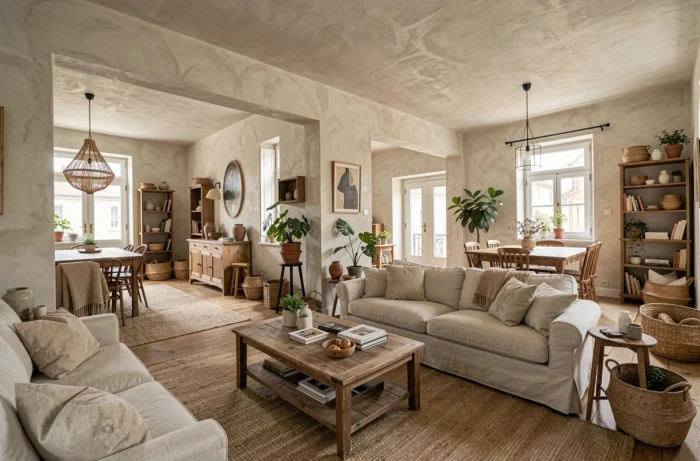
When moving in or getting tired of an interior, the instinct is often to change everything at once. The result: a blown budget and hasty choices. A much more pronounced effect is achieved by targeting a strong gesture per room, tailored to the actual use of each space. Here are ten concrete ideas to decorate your interior without falling into the generic catalog.
1. Lime plaster in the living room to break the drywall effect
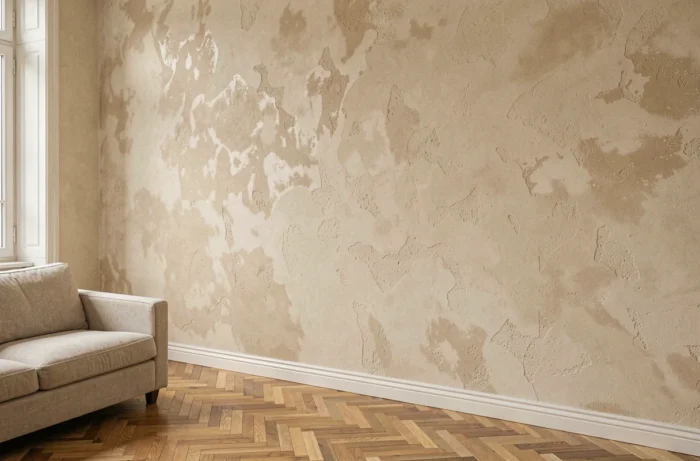
A living room with smooth white walls always ends up looking like a soulless showroom. Lime plaster adds an irregular, slightly grainy texture that captures light differently depending on the time of day.
It is applied to a single wall, the one facing the main window, to enhance the play of shadows. Sand, clay, or off-white shades blend into most palettes without forcing the style. Lime plaster transforms a flat wall into a living surface, and the results vary based on the substrate (plaster, concrete, old peeled wallpaper).
2. Rattan caning on kitchen cabinet fronts
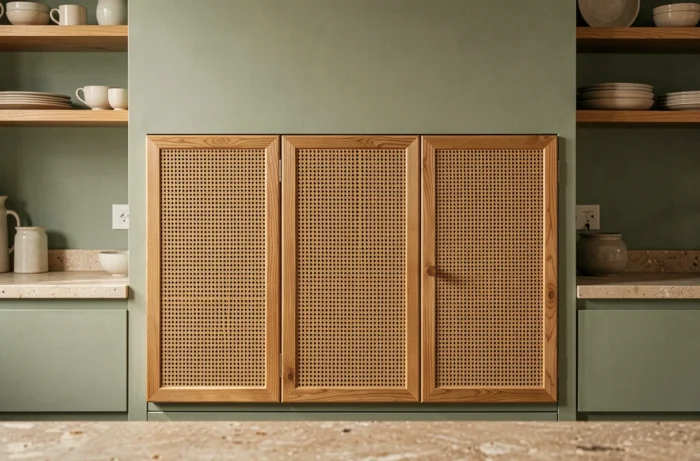
Replacing two or three upper cabinet doors with caned panels visually lightens a kitchen, especially when the cabinets reach the ceiling. The caning allows glimpses of the contents without fully exposing them, giving a tidy look effortlessly.
Today, there are ideas for decorating your interior that incorporate caning in both contemporary and rustic kitchens. Specifically, cut a pre-woven caning panel to the size of the door, and attach it with thin oak or beech strips glued to the frame. The cost remains modest compared to a complete facade change.
3. Seagrass in the entryway to structure the passage
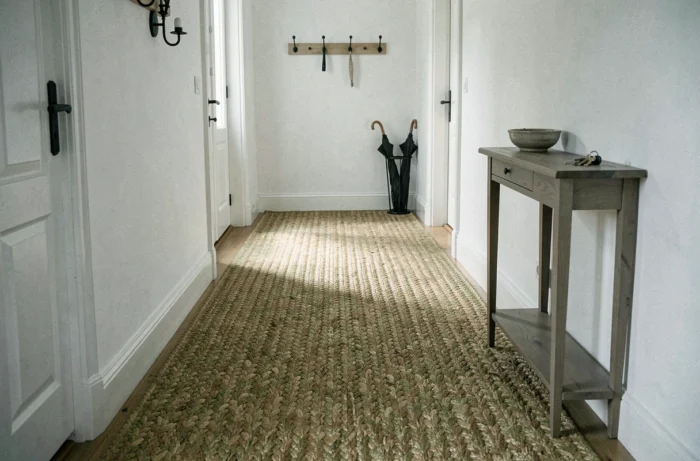
The entryway is often the most neglected room. A seagrass covering laid on the floor clearly defines the passage area and imposes a style as soon as you step inside. Its woven texture withstands daily foot traffic well.
Seagrass acts as a visual signal that separates the outside from the rest of the house. It should not be laid in humid rooms (bathroom, laundry), but in a ventilated entryway, it lasts for several years without damage.
Drenching: a single color from floor to ceiling in the bedroom
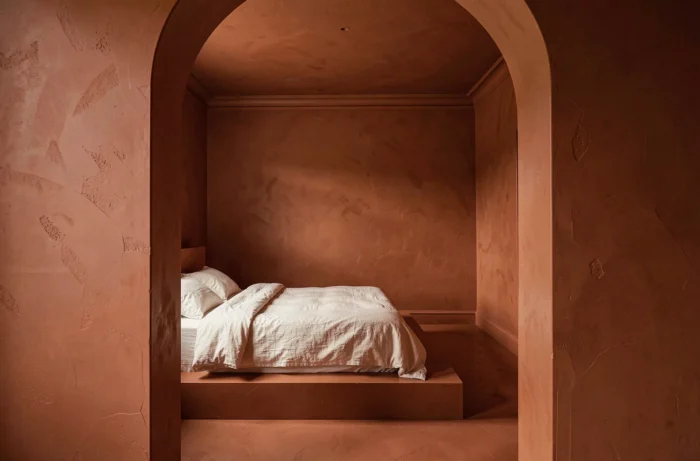
Drenching involves applying the same shade to the walls, ceiling, baseboards, and sometimes the woodwork. This technique, identified as one of the major decor trends of 2025, radically changes the perception of space with a single yet structuring gesture.
In a bedroom, enveloping tones are favored: sage green, midnight blue, terracotta. Drenching eliminates visual break lines between wall and ceiling, creating a cocoon-like feel. The effect is particularly striking in small rooms where white/color contrasts highlight the narrowness.
5. Linen and boucle textiles to redefine the master suite
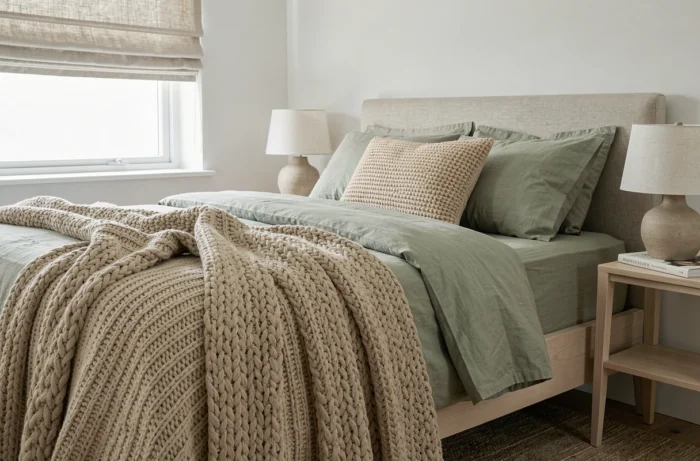
Changing the bedding, curtains, and two cushions is enough to alter the atmosphere of a bedroom without touching the walls. Washed linen and boucle are among the favored tactile materials in 2025-2026 interiors, for their both raw and soft appearance.
Choose similar shades (ecru, greige, warm white) to create coherence through material rather than color. Linen naturally wrinkles, contributing to a relaxed atmosphere. Boucle, on the other hand, adds volume to seating or headboards.
6. Reversible furniture in the living room for flexibility
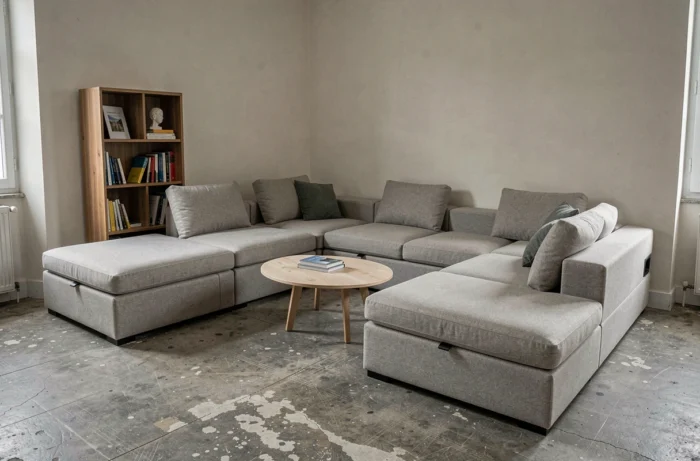
The emergence of so-called “fluid” furniture addresses a concrete problem: living spaces serve as both office, dining room, and living room. An extendable console that becomes a dining table, an ottoman with built-in storage, a wheeled shelf that serves as a mobile partition – these pieces allow for reconfiguring the space as needed.
A reversible piece replaces two fixed pieces and frees up floor space. It enhances circulation without sacrificing functionality.
7. Low lighting in the dining room to create an ambiance
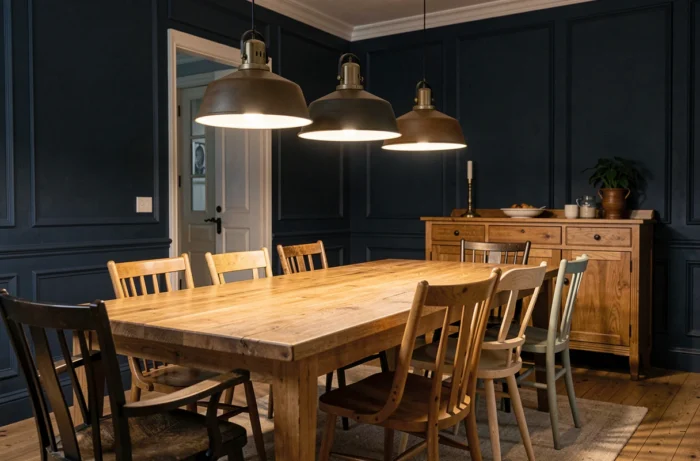
A pendant light lowered to about an arm’s length above the dining table concentrates the light on the useful area and leaves the rest of the room in soft shadow. This is referred to as ambient lighting in contrast to the general ceiling lighting.
Natural materials (rattan, wood, raffia) filter the light and cast graphic shadows on the walls. Combined with a warm temperature bulb, they transform an ordinary meal into a more relaxed moment.
8. Personal objects displayed instead of store-bought decor
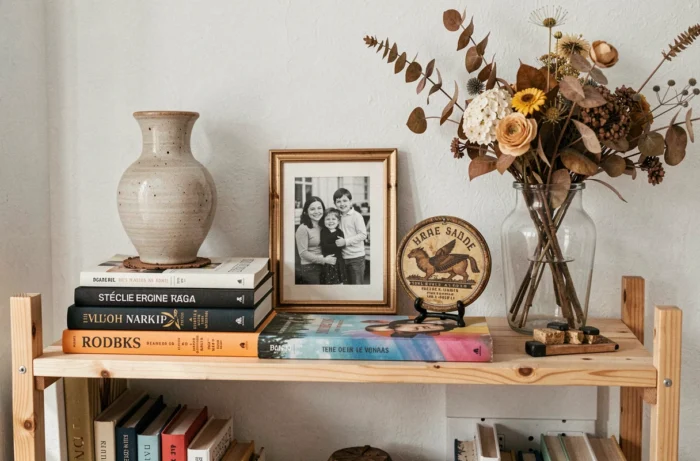
Decor trends for 2027 point towards a priority for authenticity: interiors are moving away from overly uniform atmospheres to spaces where personal memories take center stage. Specifically, replace identical decorative candles with:
- Pottery brought back from travels, even imperfect, placed on an open shelf
- Books stacked by format rather than color, reflecting your actual readings
- Mismatched frames with photos or illustrations collected over time
A personal interior is built through slow accumulation, not by bulk ordering.
9. Raw wood in the bathroom to break the all-tile look
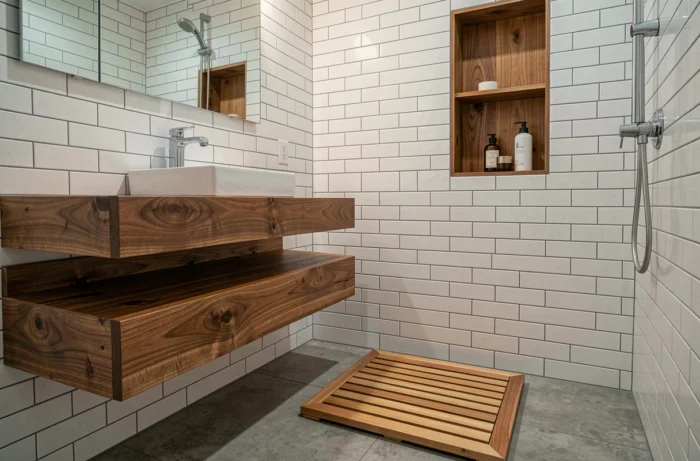
A solid oak vanity top or a walnut shelf above the toilet introduces a living material into a often cold room. The wood should be oiled or varnished to withstand humidity, but once protected, it ages well and develops a patina.
Do not cover the entire bathroom in wood. A single element is enough to break the monotony of white tiles and warm up the ambiance. The contrast between the regularity of the tiles and the irregular grain of the wood does all the visual work.
10. Bold color on an antique piece to energize a hallway
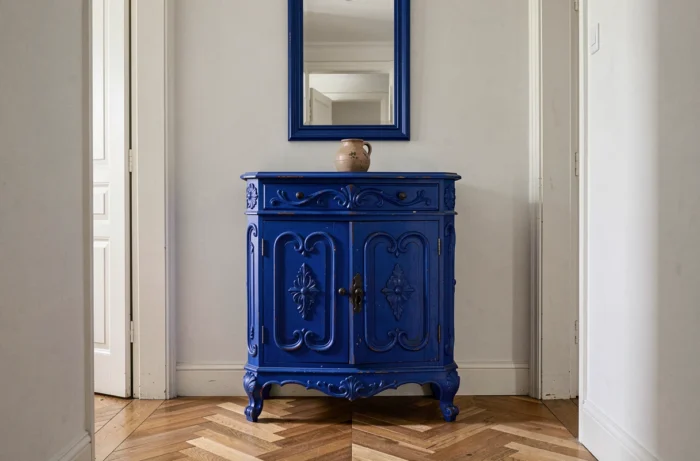
Hallways and transitional spaces are rarely decorated. Placing a thrifted chest of drawers, repainted in a bold color (duck blue, terracotta, forest green), transforms a functional passage into a point of interest.
Repainting an antique piece costs a fraction of the price of a new piece and yields a unique result. Lightly sand, apply two coats of paint suitable for the surface, and the piece changes its register without losing its original character. It is one of the most cost-effective decor gestures for secondary rooms.
Each room in the house has its own use, rhythm, and light. Rather than imposing a uniform style everywhere, it is beneficial to treat each space as a distinct project, with a targeted material or gesture. A plaster here, a textile there, a repainted piece in the hallway: coherence comes from the care given to each choice, not from a catalog applied in series.