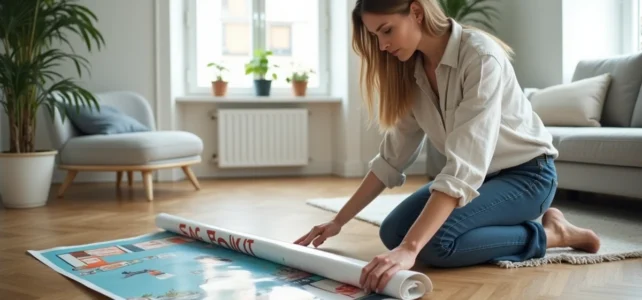
You walk past a bus shelter, the poster catches your eye, and you wonder how to get it before it ends up in the bin. The good news: JCDecaux agents give away posters upon request at the time of change. The challenge is being in the right place, at the right time, with the right approach.
JCDecaux Poster Changes: Where and When to Try Your Luck
No need to search for an online form or contact a depot. The only method that works is direct contact with the agents during their replacement rounds on urban furniture.
These teams work on bus shelters, columns, and scrolling panels. When asked politely, they sometimes agree to hand over the posters they have just removed. Nothing is guaranteed, and the policy varies by teams and cities.
In practice, you identify the furniture displaying the visual you are interested in, then return to the area one weekday morning as early as possible. Arriving late in the morning is often too late: the poster has already been replaced and loaded onto the truck.
If you are looking to retrieve JCDecaux posters for your home, target two or three bus shelters close to your home rather than scouring an entire neighborhood. Consistency pays off more than the area covered.
Responses vary by city and teams. Some agents accept without hesitation, while others systematically refuse. Politeness and punctuality make a difference.
Large Format Advertising Posters: Transport and Handling
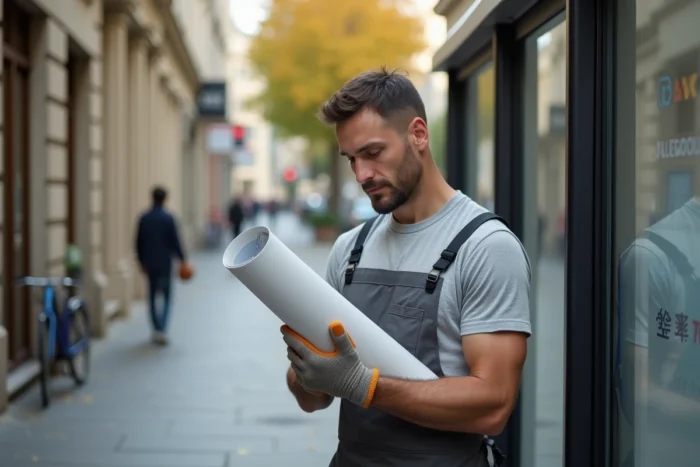
The coated paper of bus shelter posters is often glued on the back, sometimes still damp at the time of removal. The size exceeds what can be tucked under the arm.
Materials to Prepare on Collection Day
- A rigid cardboard tube of large diameter (like a postal tube for posters) or a foam protection roll, to avoid any creasing during transport.
- Thin gloves to handle the poster without leaving fingerprints on the printed surface, especially if the paper remains sticky.
- A large plastic bag or waterproof cover if you need to walk or use public transport: rain or condensation can warp the paper in minutes.
When rolling the poster, the instinct would be to place the visual inward to protect it. Test both directions on a corner before committing: a tight curve can weaken the print layer depending on the type of paper used.
Removing Residual Glue Before Framing
Posters retrieved from urban furniture almost always retain traces of glue on the back. Any hasty intervention risks damaging the paper or the print.
On the printed side, moisture dissolves the ink. It’s better to let the poster dry flat for at least a day, printed side up. Drying flat under a light weight eliminates most ripples without degrading the visual.
Movie Posters: A Often Simpler Alternative
Cinemas renew their visuals every week, making them a regular source of large decorative posters.
Replacement usually occurs on Tuesday evenings or Wednesday mornings, during program rotations. The removed posters are either briefly stored or discarded. By asking the reception staff or the projectionist right during these slots, you regularly obtain visuals in good condition.
Compared to bus shelter posters, the approach is formally authorized by the operator, the visuals haven’t been exposed to the elements, and the size remains large enough to dress a wall. No need to get up at 5 AM either.
What the Law Allows and Prohibits
When a JCDecaux agent voluntarily hands over a poster during their rounds, there is no legal issue. The situation is different if one decides to act alone.
Opening urban furniture oneself to remove a poster is prohibited. The furniture belongs to JCDecaux or the local authority. Forcing a lock constitutes damage to public property and exposes one to prosecution.
The distinction lies in how one obtains the poster:
- Politely asking an agent on-site is legal and common.
- Peeled posters from a free expression panel in the city are tolerated, as these supports are designed for quick renewal.
- Removing a poster stuck on private walls or urban furniture without the owner’s permission constitutes an offense, even if the poster seems abandoned.
The right of ownership pertains to the support, not the visual. Once a poster is voluntarily handed to you, you can frame it, keep it, or resell it as a collectible item.
Framing and Preserving a Large Format Advertising Poster
Once at home, the main enemy remains residual moisture. Leave the poster flat on a clean surface, printed side up, for two to three days before any framing.
Standard frame sizes generally do not fit. A professional framer can create a custom frame, but the cost often exceeds that of the poster itself. A cost-effective alternative: magnetic wooden strips, sold online, that hold the top and bottom of the visual without drilling or glass.
Exposure to direct sunlight accelerates fading. A wall shielded from light significantly prolongs the life of the colors.
The hardest part of the whole process is not the preservation or framing. It’s hitting the right time slot, in the right place, facing an agent willing to hand you the poster.