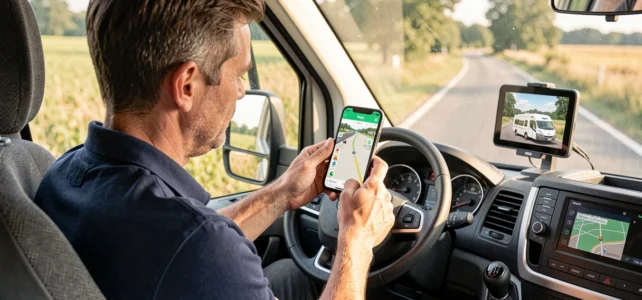
Waze offers three vehicle profiles: Car, Taxi, and Motorcycle. There is no caravan mode, no field to enter height, length, or GVW. The app therefore ignores all size constraints related to a trailer. We recommend using it for what it does well (real-time traffic, community reports) and delegating the route calculation for size-compatible itineraries to a second tool, prepared in advance.
Plan B Strategy: Prepare a caravan route outside of Waze before hitting the road
Waze is meant to get you to a meeting point, not to map out the entire route. The real routing work is done before departure, on a tool that manages the dimensions.
The principle is simple. You prepare your route on a dedicated RV/caravan app or GPS that incorporates height, weight, and width restrictions. You extract the key stops: rest areas, accessible gas stations, mandatory waypoints. Then, you enter these points one by one into Waze as intermediate destinations.
Waze then calculates short segments between each stop. On a segment of a few dozen kilometers, the risk of encountering a low bridge or an impassable road decreases significantly compared to a journey of several hundred kilometers calculated in one go. You benefit from real-time traffic alerts while maintaining a validated traffic corridor for your dimensions.
Before starting navigation, it is useful to set up Waze for caravans by adjusting the settings detailed in the next section, which further reduce the risks of unpleasant surprises on the road.
Waze Settings to Lock Before Each Caravan Departure
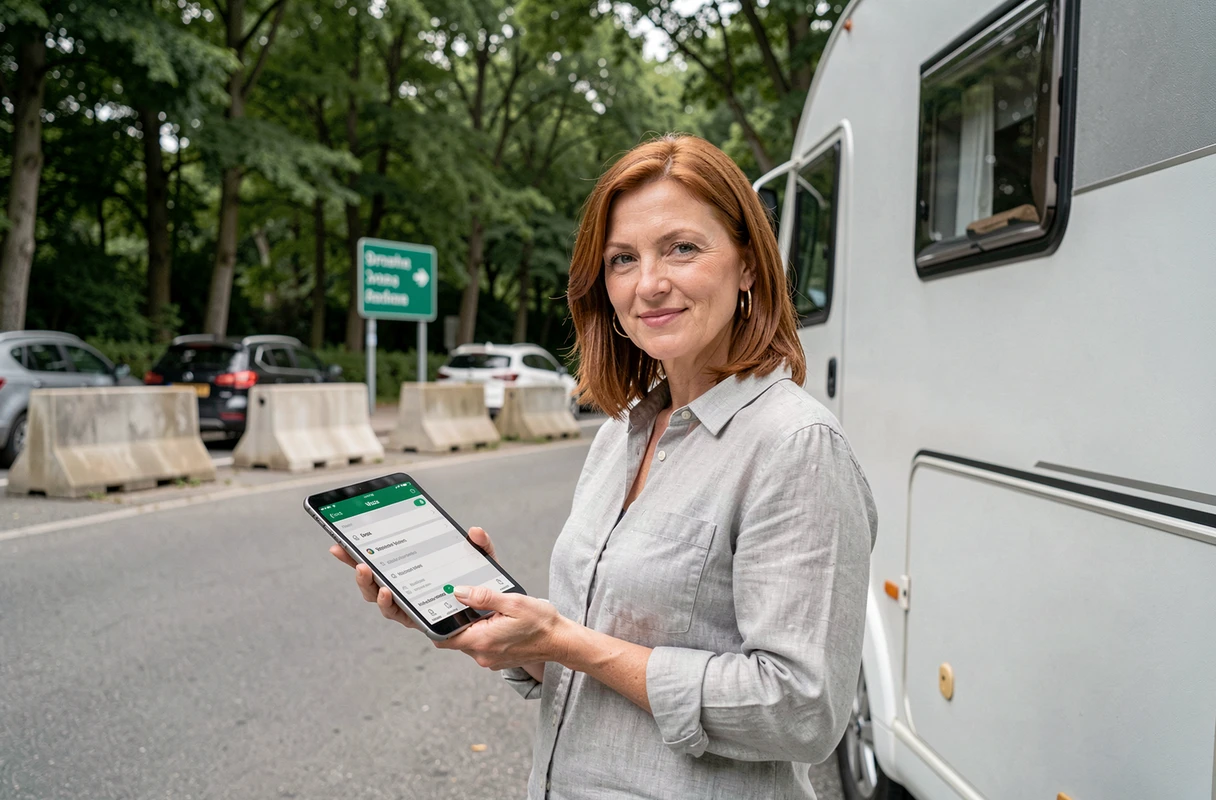
Some settings are available in Waze’s navigation settings and radically change the type of roads proposed. We consider them non-negotiable when towing.
- Avoid unpaved roads: activate this option in the route preferences. A dirt track with a trailer several meters long guarantees a U-turn or worse, getting stuck.
- Avoid ferries: unless your route requires it, disable crossings. The tight timing of a ferry combined with waiting in line with a trailer creates unnecessary stress.
- Avoid highways or tolls (depending on your preference): when towing a caravan, driving on national roads allows you to bypass costly tolls and avoid sections where the trailer’s speed disrupts highway flow.
- Enable community alerts: reported hazards, objects on the road, stopped vehicles. These Waze reports become increasingly important when the stopping distance is extended by the weight of the caravan.
A often overlooked point: disable the suggestion of difficult intersections if the option appears in your version. Waze may suggest shortcuts with tight turns or intersections with no visibility, incompatible with a turning radius expanded by the trailer.
The Trap of Route Updates on the Go
Waze constantly recalculates. On a car trip, this is an advantage. When towing a caravan, a recalculation may send you on a narrow detour to save two minutes. We recommend not automatically accepting alternative routes suggested during navigation. First, visually check on the map if the new route goes through dense urban areas or unknown secondary roads.
Data Connection Management and Offline Preparation
Waze relies on an active mobile connection to function properly. In rural or mountainous areas, network coverage becomes unreliable, compromising both real-time traffic and route recalculation.
Always start your route on Wi-Fi before leaving. Waze will then load the map data for the planned route. If the network is lost, navigation continues in degraded mode on the data already cached, but without traffic updates.
Activate the data saver in the app settings. This option reduces background consumption and limits non-priority data downloads. On a journey lasting several hours, the difference in data consumption is noticeable.
Complement Waze with an Offline Map
Keep an offline mapping app (OsmAnd, Maps.me, or equivalent) with the area of your route downloaded on your phone or tablet. If Waze loses signal and you need to improvise a detour, you have a map background that can be consulted without a network, for free and without additional registration.
Why Waze Remains Useful Despite the Lack of a Caravan Mode
Waze will not replace a specialized GPS for calculating caravan routes. However, no other free app matches the responsiveness of its community traffic alerts. Traffic jams, accidents, roadworks reported in real-time by other drivers: this information is invaluable when towing, as an unexpected stop with a trailer on a highway ramp is far more problematic than in a solo car.
The most reliable approach is to use Waze as a traffic monitoring layer over a pre-validated route. You are not asking it to think for you; you are asking it to alert you to what is happening ahead.
Prepare the route on a size-compatible tool, break it down into short steps, lock the anti-shortcut settings in Waze: plan for about twenty minutes before departure to secure a route suitable for your trailer.