
The French Riviera has specific health constraints that generic wellness guides do not address: cumulative UV exposure on a south-facing coastline, recurring heat peaks in densely populated urban areas, and a network of care that operates according to precise rules of availability. Adapting one’s daily health and wellness routine in this territory requires knowledge of these particularities rather than applying standardized advice.
Availability of care on the French Riviera: the system to know
The ARS PACA maintains a formal organization of care availability in the region, with defined time slots during the night, on weekends, and on public holidays. This system includes a dental on-call service and pharmacies on duty, coordinated at the departmental level.
We observe that many residents and families on vacation are unaware of this system and overwhelm hospital emergency rooms for issues that fall under general practice. Inquiring about the on-call doctor in the area before a long weekend can prevent several hours of waiting at the CHU of Nice or the hospital in Cannes.
For healthcare professionals and local structures that centralize this information, a useful resource remains https://www.rivierasante.fr/, which facilitates orientation towards practitioners in the Riviera territory.
Cumulative sun exposure and UV prevention on the Mediterranean coast
The annual sunshine on the Riviera coastline far exceeds that of most French regions. The trap lies not in occasional sunburn, but in chronic low-intensity exposure, especially in the off-season, when vigilance decreases while the UV index remains significant.

Dermatologists in the area note a prevalence of actinic keratoses among patients who claim to “never get sunburned.” Gradual tanning without burning does not protect against skin aging or the risk of carcinoma.
In this territory, we recommend three reflexes that are rarely applied by permanent residents:
- Apply daily sun protection on the face and hands even in winter, not just during beach outings. Cumulative exposure during walks or sitting on terraces accounts for the majority of the annual UV dose.
- Consult a dermatologist for a skin screening exam at least once a year, especially after several years of residence on the French Riviera.
- Favor outdoor activities early in the morning or late in the day between May and September, which also aligns with managing heat episodes.
Heatwave vigilance in the Alpes-Maritimes: adapting daily wellness
Episodes of yellow heatwave vigilance in the Alpes-Maritimes are increasing, with temperatures reaching 31 degrees on the beaches and 33 degrees in the inland areas. These figures, reported by local weather bulletins, reflect a reality that new residents underestimate.
Heat directly impacts sleep quality, physical recovery, and concentration ability. For families with children, managing hydration and daily rhythm becomes a significant public health issue, not just a comfort suggestion.
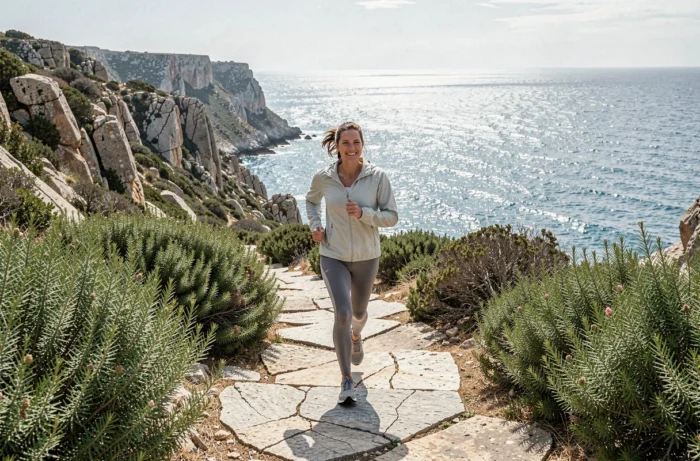
Rethinking one’s physical activity routine according to the season is a necessity on the French Riviera. Jogging at noon by the sea, popular among tourists, exposes one to thermal stress that negates the cardiovascular benefits of exercise. Rescheduling sessions before 8 AM or after 7 PM is not optional during the summer.
Thermalism in Provence-Alpes-Côte d’Azur: an underutilized health lever
Regional thermalism remains structured around stations like Digne-les-Bains and Gréoux-les-Bains, accessible for short stays from the coast. These stations offer conventioned treatments as well as shorter formats focused on prevention, positioning them as realistic complements to a wellness routine.
The mobility angle deserves attention: some thermal stations have camper van areas, which opens up the possibility of flexible health stays without hotel constraints. For a family based in Nice or Antibes, a thermal weekend in Digne-les-Bains represents less than two hours of driving.
Thermalism is not reserved for serious pathologies. Health prevention programs, currently being developed in several French thermal establishments, target chronic stress, musculoskeletal disorders, and post-effort recovery, all common issues among active individuals in the region.
Drowning prevention on the French Riviera: a real summer health risk
Public Health France reports that during the period from May 1 to July 15, 2026, in PACA, while the overall number of drownings has decreased compared to 2025, the proportion of drownings followed by death has increased. This finding should alert families visiting the French Riviera.
Swimming in the Mediterranean Sea presents specific risks: localized coastal currents, thermal shocks due to the difference between ambient temperature and water temperature, and uneven surveillance depending on the beaches. Unmonitored beaches between 12 PM and 2 PM account for a disproportionate share of incidents.
Integrating drowning prevention into a comprehensive daily health approach on the French Riviera requires systematically checking swimming conditions, never swimming alone, and respecting a digestion time often neglected out of habit.
Daily health on the French Riviera is not just about eating well and exercising. It involves understanding the local healthcare system, managing sun and heat exposure wisely, and integrating regional resources like thermalism. These territorial adjustments make the difference between a lifestyle that is endured and one that is truly adapted to the Mediterranean coastline.