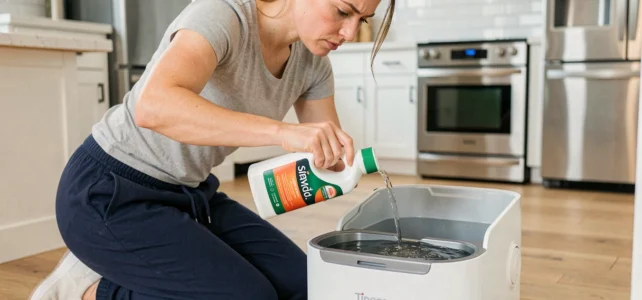
Tineco floor washers integrate sensors that automatically adjust the suction power and water flow based on the level of dirt detected on the floor. This technology relies on an internal circuit where water flows through components sensitive to chemical residues. Adding a third-party product like Sanytol to the tank raises a specific technical question related to the chemical compatibility between a consumer disinfectant and a device designed to operate with its own solution.
iLoop Sensors and Hydraulic Circuit: What Sanytol Can Disrupt
The Tineco iLoop system uses optical or infrared sensors to analyze the turbidity of dirty water. These sensors distinguish water laden with particles from clean water and adjust the power accordingly.
A disinfectant like Sanytol contains surfactants and biocidal active ingredients. When these substances pass through the circuit, they can leave a film on the internal walls of the sensors. The sensor then misinterprets the level of dirt, skewing the device’s automatic settings.
The problem may not manifest immediately. It is the accumulation of residues, cleaning after cleaning, that gradually degrades the reliability of detection. A user wondering if Sanytol foams in the tank is also touching on the second major risk: the formation of foam in a circuit not designed to handle it.
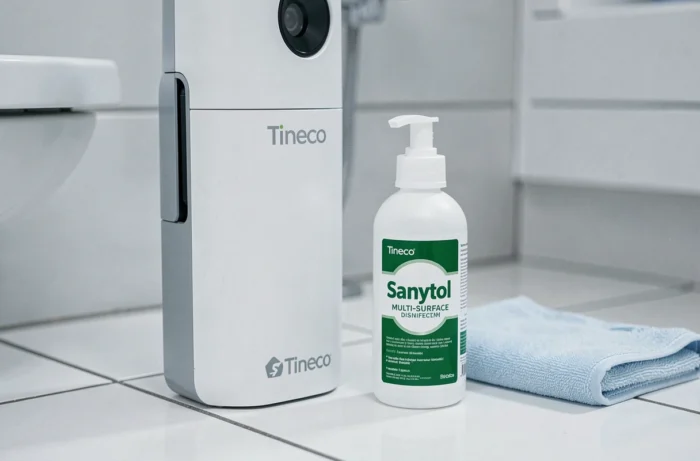
Foam and Sanytol Dosage in a Tineco: The Critical Threshold
Foam poses the most immediate danger. Tineco floor washers operate with a low-pressure circuit, where clean water flows by gravity to the rotating brush. Any excessive foam rises in the suction duct and can reach the motor or electronic components.
Sanytol, even in its multi-surface version, foams as soon as it is agitated. The simple passage of the rotating brush over the floor is enough to create this agitation. Some users report that half a cap per tank does not produce visible foam, but the absence of foam on the surface does not guarantee the absence of foam in the internal circuit.
What Reduced Dosage Does Not Solve
Reducing the amount of Sanytol limits foam formation, it’s true. However, it does not address two other issues:
- Biocidal residues continue to accumulate on the rubber seals and plastic fittings of the circuit. These materials can degrade with repeated exposure to chemical agents not intended by the manufacturer.
- The pH of Sanytol differs from that of the official Tineco solution. Over the long term, an unsuitable pH accelerates the wear of internal components, particularly the seals.
- The manufacturer’s warranty exclusively covers use with the Tineco solution. Damage noted during a return to customer service, with traces of third-party products, may result in a denial of coverage.
Official Tineco Solution vs. Alternatives: A Real Formulation Gap
The Tineco multi-surface cleaning solution (Deodorizing & Cleaning Solution) has been formulated not to foam in the device’s circuit. Its composition is calibrated for a neutral pH compatible with the internal materials of the washer: polycarbonate of the tank, silicone of the seals, surface of the iLoop sensors.
The most recent Tineco manuals, including that of the recently published S6 Stretch Plus, now specify the following instruction: use only the Tineco solution, with a dosage of one cap per tank of clean water. This formulation has been tightened compared to previous generations, where the manufacturer merely discouraged third-party products without formally prohibiting them.
Why Tineco Has Tightened Its Guidelines
The increase in customer service returns related to clogged sensor issues or motors damaged by foam has prompted the brand to explicitly restrict authorized products. The latest Tineco manuals prohibit any generic disinfectant in the tank, not just Sanytol.
This evolution also affects other floor washer manufacturers like Dreame, whose recent manuals impose similar constraints: mandatory proprietary solution, prohibition of foaming soaps and commercial disinfectants.
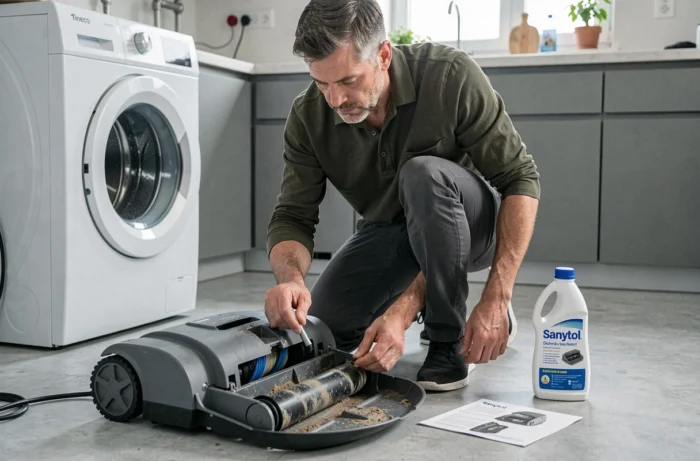
Disinfecting Floors with a Tineco: Options That Work
If the goal is to achieve a disinfected floor, the official Tineco solution cleans effectively but does not claim to disinfect in the biocidal sense. Two approaches allow for combining Tineco and disinfection without compromising the device.
The first involves using the Tineco with its official solution to clean the floor, then applying Sanytol separately with a traditional mop or spray. The mechanical cleaning of the Tineco removes most dirt, and Sanytol then acts on an already clean surface, which actually enhances its biocidal effectiveness.
The second option concerns Tineco models equipped with a steam function, such as the S7 Steam. High-temperature steam eliminates a very large proportion of bacteria and germs without any chemical products. Steam replaces the disinfectant without risk to internal components.
What to Remember About Sanytol and Tineco Compatibility
Sanytol will likely not destroy a Tineco on first use. The risk is gradual: clogging of sensors, degradation of seals, internal foam formation. Each of these issues shortens the device’s lifespan and exposes it to warranty denial. The official Tineco solution, despite its higher cost, remains the only validated option to preserve the mechanical and electronic integrity of the washer.