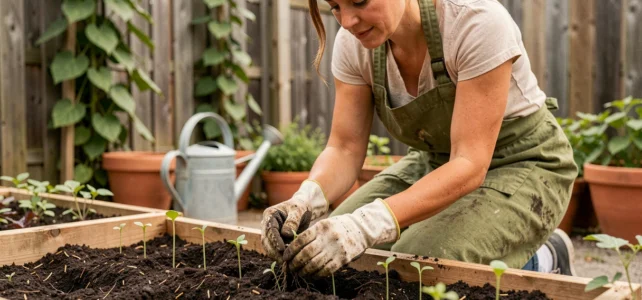
A productive vegetable garden year-round does not rely on a sowing calendar displayed on the wall. It requires careful management of water resources, a biologically active soil at all times, and varietal choices suited to each climatic window. Here, we discuss the technical levers that make the difference between a seasonal vegetable garden and continuous production.
Water management in the vegetable garden facing summer restrictions
Prefectural water restriction orders have become a structural constraint for summer vegetable gardens in France. In many departments, watering gardens is prohibited between 8 AM and 8 PM as soon as a drought alert level is reached, with total bans possible at crisis level. Ignoring this regulatory framework exposes one to fines, but more importantly, compromises any crop planning during the July-October period.
We recommend separating two supply circuits. The first relies on rainwater harvesting, which generally escapes restrictions as long as the storage was established before the order came into effect. A sufficiently sized tank connected to the gutters allows for drip irrigation even during a heatwave.
The second lever is the drastic reduction of water needs in the soil. A systematic thick mulch (straw, wood chips, hay) limits evaporation and maintains biological activity on the surface. Combined with watering early in the morning or late in the evening (the only permitted time slots), this setup is sufficient to meet the needs of most fruiting vegetables.
To deepen your choices of suitable varieties and equipment, exploring the vegetable garden with Tradition Jardin allows you to cross-reference technical references with the constraints of your land.
Living soil and continuous fertility: the foundation of a year-round vegetable garden
A bare soil between two crops is a soil that regresses. The fertility of an annual vegetable garden is built through permanent soil coverage, whether plant-based or organic. Green manures sown as soon as a bed is freed (mustard, phacelia, rye depending on the season) fix atmospheric nitrogen, structure the soil deeply, and prevent winter leaching of nutrients.
Mature compost remains the best versatile amendment, but its application benefits from being split. A single application in autumn loses some of its elements through leaching before spring crops can benefit from it. We recommend two applications: the first in autumn to nourish the soil life during winter, and a second in spring on the surface, incorporated by earthworms.
Soil health indicators to monitor
- The presence of earthworms in numbers when using a trial spade (a scoop of soil from the top few centimeters) indicates sufficient biological activity to decompose crop residues.
- A forest floor smell at the mulch level indicates correct aerobic decomposition, while a swampy smell signals excess moisture and compaction that needs to be corrected.
- The soil sausage test (forming a sausage between the fingers) provides information about texture: if it cracks without sticking, the structure is favorable for roots.
A soil that meets these three criteria supports tight rotations without exhaustion, which is the basic condition for chaining crops over four seasons.
Planning crop successions for continuous harvest
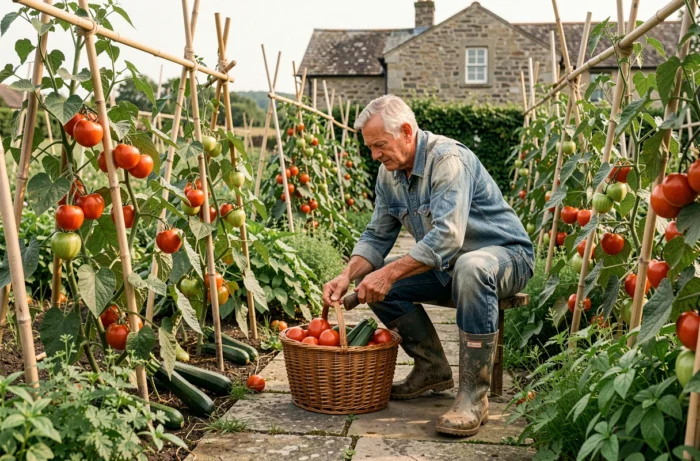
Year-round production relies less on the number of varieties grown than on the precise succession of beds between crops. The classic trap is to leave a space empty after harvesting tomatoes or zucchinis while waiting for the following spring. This void represents several months of lost production.
As soon as a bed is freed at the end of summer, it can accommodate sowings of lamb’s lettuce, winter spinach, or black radishes. These short-cycle or cold-resistant crops occupy the ground until December, or even February under forcing cover. The goal is to never leave a bed inactive for more than two weeks.
Associations and staggering of sowings
Staggering sowings of the same species over three to four weeks avoids the harvest peak followed by a void. For salads, we practice sowing every two weeks from March to September, which ensures almost permanent availability.
Associating crops with different cycles on the same bed also saves time. Sowing radishes between rows of carrots utilizes space while the carrots slowly emerge. The radish is harvested before the carrot needs the space, with no real competition between the two species.
Winter protection and extending harvests in the vegetable garden
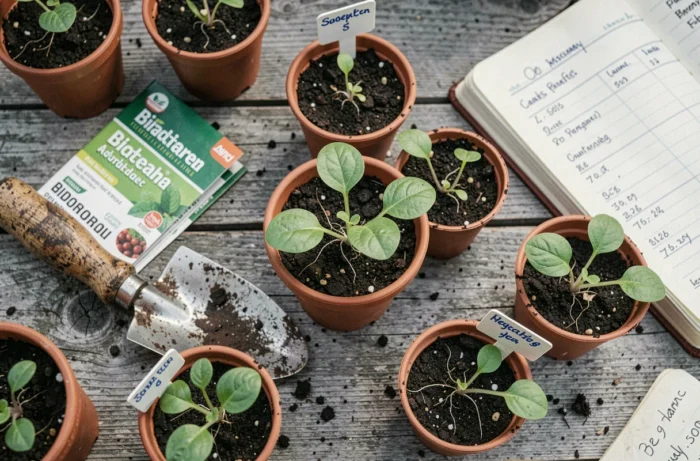
Growing in winter does not require a heated greenhouse. A simple winter cover or forcing bell is enough to gain several degrees around the plants and extend the harvests of leeks, cabbages, beets, and lamb’s lettuce well beyond the first frosts.
Cold-resistant mulching protects the roots even in negative temperatures. A thick layer of straw or dead leaves around root vegetables (Jerusalem artichokes, parsnips, carrots) allows them to remain in the ground and be harvested as needed, like a natural pantry.
Cold frames placed on raised beds create a microclimate that allows for early sowings as soon as February. Lettuce, spinach, and broad beans find sufficient conditions to germinate without artificial heating. This few-week shift at the beginning of the season impacts the entire succession chain: the first bed freed earlier quickly accommodates the next crop.
A vegetable garden that produces year-round is managed like a tight schedule where each bed has an occupant. Summer water constraints, permanent soil coverage, and overlapping crop cycles form the three pillars of this continuity. The final margin for improvement lies in adapting the varieties to your local pedoclimatic context, as this is where the last opportunity for progress occurs.