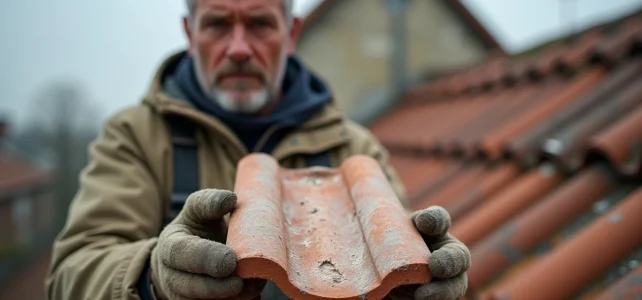
Terracotta tiles are porous by nature. Their fired clay structure traps micro-bubbles of air which, over time, become points of entry for water. This porosity is not a manufacturing defect, but a physical property of the material. The problem arises when this porosity exceeds a threshold where the tile no longer fulfills its waterproofing role, exposing the framework and insulation to damage that can sometimes go unnoticed for years.
Absorption test on tiles: distinguishing normal porosity from excessive porosity
Before climbing onto a roof or contacting a roofer, a simple protocol allows for assessing the condition of a tile. Just drop a drop of water on a dry tile and time its absorption.
If the water penetrates in 30 seconds to 2 minutes, the tile is healthy and its porosity remains within normal limits. Below 30 seconds, the absorption is almost immediate, indicating excessive porosity. Beyond 2 minutes, the surface still retains a satisfactory waterproofing ability.
This test, which can be performed on a removed tile or one accessible at the roof edge, provides a reliable indication without specialized equipment. It mainly helps avoid unnecessary treatments on tiles whose porosity falls within the normal behavior of terracotta. To delve deeper into the process, knowing how to identify a porous tile on Toute La Maison helps to complement this initial visual diagnosis with other field criteria.
Visible signs from the ground: what the roof surface reveals
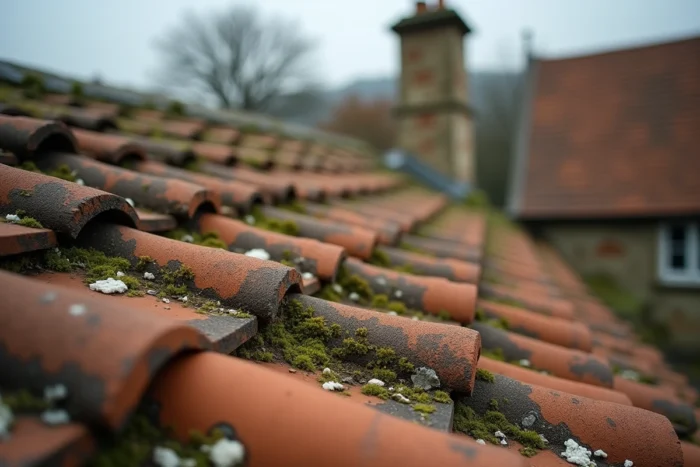
Observing your roof from the garden or the street already provides useful clues. A new tile has a smooth, almost glossy appearance. When this appearance fades and the surface becomes matte, grainy, or powdery, erosion has begun to wear away the protective layer.
Three signals should draw attention:
- Areas where the color of the tiles differs significantly from the rest of the roof, with a darker appearance after rain that persists for several days, indicating that water is stagnating in the material instead of running off.
- Greenish or black streaks concentrated on certain rows, where mosses, lichens, and algae settle more easily because the surface provides a grip for their roots.
- Visible chips or flaking at the edges of the tiles, often caused by freeze-thaw cycles on waterlogged terracotta.
These observations do not replace a roofer’s diagnosis, but they help prioritize an intervention. An abnormally slow drying after rain remains the most telling marker for a non-professional.
Replacement threshold or waterproofing treatment: the proportion criterion
The most common question regarding aging tiles is about the choice between treatment and replacement. Field feedback suggests an operational criterion that is rarely formalized in quotes.
If less than 30% of the tiles exhibit very high porosity (almost immediate absorption, very slow drying), a surface waterproofing treatment remains viable. Only the most degraded tiles are then replaced, followed by the application of a waterproofing product over the entire roof.
Beyond this proportion, the waterproofing treatment only delays an inevitable outcome. The cumulative costs of treatment, occasional replacement, and sealing repairs eventually exceed those of a complete renovation.
The available data do not allow for setting a universal threshold, as the quality of the original terracotta, climatic exposure, and roof slope modify the equation. However, this 30% benchmark provides a useful order of magnitude to guide discussions with a roofer.
Beware of high-pressure cleaning
The high-pressure cleaner is often the first reflex when faced with a dirty roof. On already porous tiles, high pressure exacerbates surface degradation by widening the micro-cavities of the clay. The pressure also dislodges fine particles that partially clog the pores, accelerating water absorption during subsequent rains.
Manual brushing or a low-pressure anti-moss treatment better preserves the integrity of the material. The additional time cost is real, but it prevents turning a cleaning into an additional wear factor.
Waterproofing treatment on terracotta tiles: application conditions and lifespan
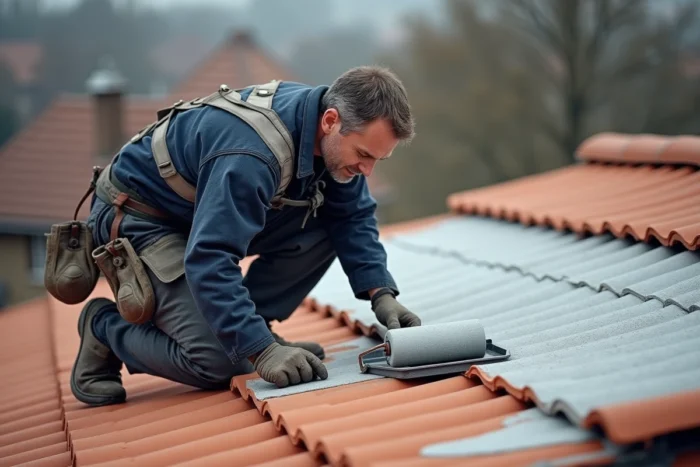
A waterproofing agent is applied to a clean, dry surface free of any vegetation. Skipping the cleaning step means waterproofing a layer of moss, not the tile itself. The application should be done in dry weather, over several days without forecasted rain, typically in spring or early autumn.
Two families of products coexist on the market:
- Film-forming waterproofing agents, which leave a film on the surface. They offer immediate protection but may flake over time and require more frequent renewal.
- Beading waterproofing agents (impregnation), which penetrate the pores without blocking the tile’s breathability. The beading effect allows water vapor to escape while repelling rainwater, which limits the risks of condensation under the covering.
The lifespan of a waterproofing treatment varies depending on the product, exposure, and quality of preparation. Field feedback diverges on this point, with some professionals reporting several years of protection while others observe more rapid degradation in oceanic climates or on north-facing slopes.
The role of the framework diagnosis
Treating the tiles without inspecting the framework underneath is akin to treating a symptom. If moisture has already penetrated the covering for months, the rafters and battens may show signs of rot or fungal attack. A framework diagnosis before any surface treatment prevents investing in a waterproofing agent on a structure that is already compromised.
The presence of dark stains on the framework wood, a musty smell in the attic, or dried water marks on the insulation are all clues to check before validating a simple covering treatment. The roofer and carpenter ideally work together to provide a complete diagnosis, from the outer surface to the load-bearing structure.