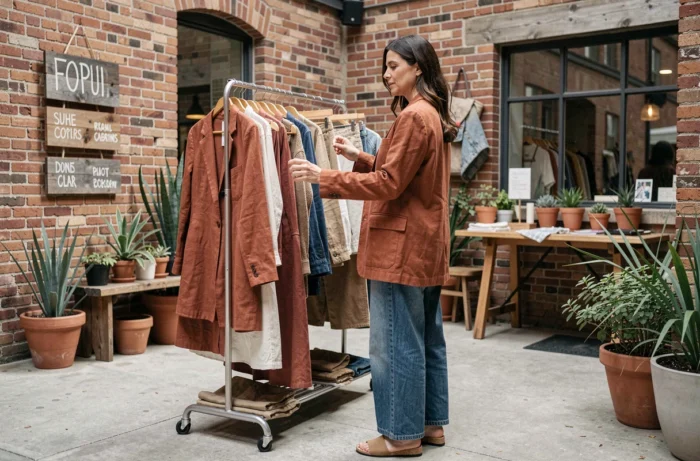
When a French upcycling brand like Collectivo presents its autumn-winter 2026 collection entirely made from production scraps recovered from Italian manufacturers, we understand that committed fashion has changed its ground. We are no longer talking about “green” capsules slipped between two classic collections, but about regulatory constraints that redefine the wardrobes offered in stores.
European Regulation on Unsold Textiles: What Changes in Store
Since July 19, 2026, large fashion companies operating in the European Union are no longer allowed to destroy their unsold clothing, accessories, and shoes. The European regulation on eco-design for sustainable products (ESPR) requires documentation of the fate of each surplus: reuse, repair, recycling, or donation.
In practice, this means that committed collections are no longer a marketing strategy but a legal obligation. Brands that produced excess to fuel permanent sales must rethink their volumes. We are seeing lines designed from the outset to be transformable: reversible jackets, pants with detachable legs, dresses that can be modified with a snap-button system.
For consumers, the change translates into shorter series and less frequent restocks. When we spot a committed piece we like, it’s better not to wait too long.

End of “eco-friendly” Claims Without Proof: Spotting Real Labels This Season
For a long time, labels have been adorned with terms like “eco-friendly,” “conscious,” or “carbon neutral” without any supporting data. That’s over. Starting September 27, 2026, the directive Empowering Consumers for the Green Transition makes generic environmental claims that are not verified by an independent third party illegal. Uncertified in-house labels are also banned.
In practice, when entering a store or browsing a website, one should look for recognized certifications rather than slogans. Several reliable benchmarks already exist in the French and European markets:
- GOTS (Global Organic Textile Standard) for organic cotton, covering the entire production chain, from field to finished garment.
- OEKO-TEX Standard 100 or Made in Green, which guarantee the absence of harmful substances and, for the latter, traceability of manufacturing sites.
- The European Ecolabel EU, less common in textiles but expanding, which imposes strict criteria on water and energy consumption.
As regularly explained in analyses published on the fashion section of La Télé de Gauche, distinguishing a genuine commitment from mere posturing requires looking beyond the packaging. This season, regulations are sorting things out for us, at least in part.
Upcycling and Unique Pieces: Fashion That Truly Matters
Upcycling is no longer limited to confidential workshops. Brands like Collectivo have presented their autumn-winter 2026 collection by reworking end-of-roll fabrics sourced directly from manufacturers. The result: pieces in very limited editions, often numbered, with textures and colors that cannot be found anywhere else.
Each upcycled garment carries a verifiable textile story, and that’s what appeals this season. We can trace the origin of the fabric, know the original manufacturer, and understand the transformation that took place. This traceability perfectly meets the new European requirements.
In terms of style, the trend leans towards structured cuts in reclaimed leather, oversized jackets made from multiple military parkas, or pleated skirts cut from old hotel curtains made of thick linen. Feedback varies on the durability of certain artisanal finishes, but the quality of the raw materials (often more premium than those of new collections at equivalent prices) more than compensates.

Digital Product Passport: How to Read the Identity Card of Your Clothes
Europe is preparing to roll out the Digital Product Passport (DPP) for textiles. The idea is simple: each garment will carry a QR code providing access to its complete identity card. Fiber composition, country of manufacture, estimated carbon footprint, repair instructions, and suitable recycling pathways.
We are not yet at the stage where this is mandatory for all brands, but several pioneering retailers in France and Europe are already integrating this system into their autumn-winter 2026 collections. When scanning the code, one accesses a page detailing the entire journey of the garment.
For us consumers, it’s a formidable comparison tool. Two merino wool sweaters priced the same can reveal radically different production realities once their passport is consulted. The DPP transforms the act of purchasing into an informed decision, not a gamble on a brand’s good faith.
Separate Collection of Used Textiles: Giving a Future to Your Old Clothes
The generalization of separate collection of used clothing in the European Union is scheduled for January 2025 and is being rolled out gradually. In France, collection points are multiplying in city centers and shopping mall parking lots. Several retailers also offer in-store take-back programs.
This system directly feeds into the upcycling and second-hand sectors that nourish committed fashion. When we drop off a worn-out pair of jeans at a collection point, it may end up being reworked by a creative workshop rather than being buried. The loop closes, and the committed wardrobe begins as much with what we buy as with what we pass on.
The committed fashion of this autumn-winter 2026 no longer relies on brand promises but on a European legal framework that constrains, verifies, and documents. To make clothing choices aligned with this new reality, all it takes is to flip the label, scan the QR code, and check the certifications. Style follows.