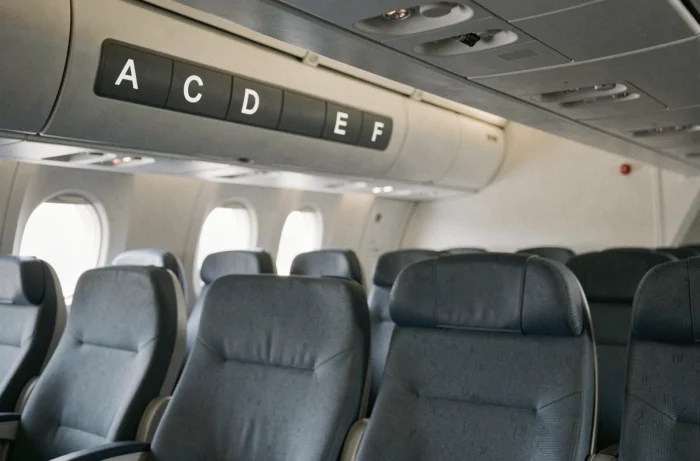
When booking a plane ticket and choosing a seat, the numbering of seats can sometimes hold surprises. On certain aircraft, the letter B simply does not exist in the cabin layout. No seat removed, no mechanical ghost: the letter has been intentionally excluded from the numbering scheme. This phenomenon, far from being anecdotal, affects several airlines and various families of aircraft around the world.
Lettering conventions according to cabin configuration
The confusion arises from a simple assumption: each letter should correspond to a physical seat. The technical reality is more nuanced. Airlines and manufacturers use lettering conventions that depend on the number of seats per row, not on a continuous alphabet.
| Configuration | Left side | Center | Right side | Absent letters |
|---|---|---|---|---|
| 3-3 (classic single-aisle) | A B C | – | D E F | G, H, J, K |
| 3-3 (alternative convention) | A C D | – | D E F | B, G, H, J, K |
| 2-2 (regional turboprop) | A C | – | D F | B, E, G, H, J, K |
| 3-3-3 (large-capacity economy) | A B C | D E F | G H J | I, K (variable) |
| 2-3-2 (large-capacity) | A C | D E F | H K | B, G, I, J |
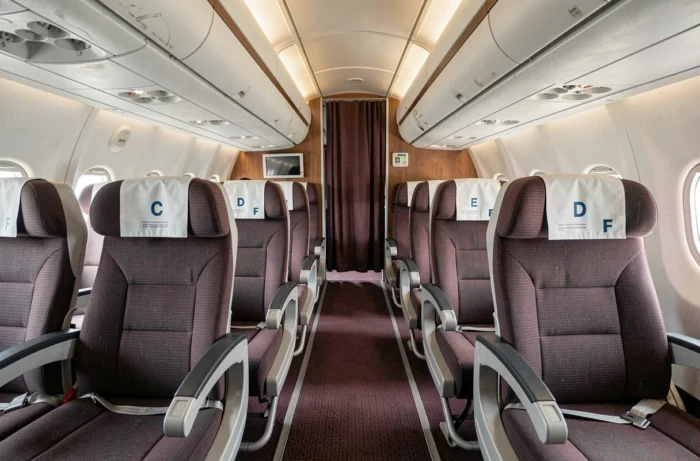
This table illustrates a point often misunderstood: the letter B disappears as soon as the row drops below three seats on the window side. On an aircraft configured 2-2 like Air Canada’s Dash 8-400, the left seats are labeled A and C, while the right seats are D and F. The letter B has never existed on these aircraft.
To understand in detail why seat B is missing on an airplane, one must look at the logic underlying this lettering: the letter A always designates the left window, and the letter C always designates the left aisle. When there are only two seats on that side, B has no place between the two.

Fleet standardization: the case of the Comac C919
The most recent and radical example of this logic comes from China. On the Comac C919 operated by China Eastern, the economy cabin is labeled A B C on the left and J K L on the right. The letters D, E, F, G, and H have been removed throughout the cabin, even though the aircraft has six seats per row.
This choice is not superstitious. It is a harmonized numbering convention across the fleet. The goal is to avoid any confusion between different types of aircraft operated by the same airline. A passenger who travels regularly knows that the letter A is at the left window, regardless of the size of the plane.
This case illustrates a shift: the numbering no longer describes the physical cabin but a fleet standard. The same letter B can designate a center seat on a single-aisle and may not exist at all on a large-capacity aircraft of the same airline. It is a deliberate choice for internal consistency, not a planning error.
Missing rows and aviation superstitions
The absence of certain letters is sometimes accompanied by the absence of entire rows. Several airlines remove row 13, considered unlucky in Western culture. Row 17 disappears on some Italian and Brazilian airlines, as the number 17 is considered bad luck in those cultures.
- Row 13 absent on Lufthansa, Air France (on some aircraft), Ryanair, and many European airlines
- Row 17 removed on some Italian and Brazilian carriers for cultural reasons
- Row 4 sometimes absent on Asian airlines, as the number 4 is associated with death in Chinese, Japanese, and Korean
These choices do not change the total number of seats on the plane. The rows are simply renumbered by skipping the relevant number. An aircraft with 30 rows will display 31 numbers if row 13 has been removed from the layout.
Letters and rows: two distinct logics
The amalgamation of missing letters and missing rows perpetuates the mystery. The absent letters (B, I, sometimes D or E) fall under a technical logic of readability and standardization. The absent rows pertain to marketing and cultural sensitivity. The two phenomena do not have the same cause, even if they produce the same visual effect on a cabin plan.
Seat B on a plane: what it changes for the passenger
The concrete impact for a traveler is limited but real at the time of booking. On a 2-2 aircraft, looking for seat B is pointless: it will not appear on the map. On a single-aisle in 3-3 with the classic convention, B exists and corresponds to the left center seat, wedged between the window and the aisle.
The trap occurs when an airline operates several types of aircraft on the same route. A flight booked on an A320 (configuration 3-3, seat B existing) may be operated at the last moment by a smaller 2-2 aircraft. The initially assigned seat B disappears, and the passenger is re-seated.
For families traveling with young children, this nuance deserves attention. Booking three seats side by side (A, B, C) on a single-aisle guarantees staying together. On a 2-2 aircraft, this configuration does not exist: they will have to split into two pairs.
The letter B is neither a mystery nor an anomaly. It reflects a numbering system designed for operational consistency, where each letter maintains a fixed position (window, center, aisle) regardless of the width of the cabin. When the middle seat does not physically exist, its letter disappears with it.