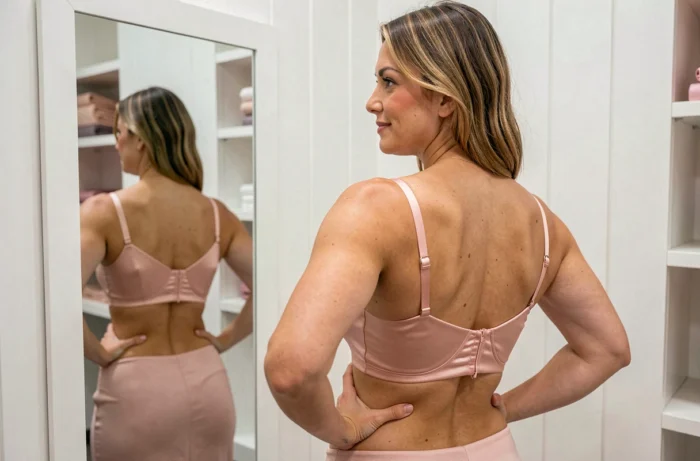
A pear-shaped bust is characterized by a volume concentrated in the lower part of the breast, with a less filled upper cup. This weight distribution creates specific support constraints: gravity pulls downwards, and most standard bras leave an empty space at the top of the cup. Understanding this mechanics allows for targeting the cuts that are truly suitable rather than going through a series of disappointing fittings.
Volume distribution and support constraints of a pear-shaped bust
The term “pear” refers to a breast whose base is wider and heavier than the upper pole. Specifically, the breast tissue projects downwards and slightly outward. This morphology is common across all sizes.
The main difficulty lies in the imbalance of cup filling. A classic bra, designed for an even distribution, leaves the top of the cup wrinkled or gaping. The bottom, on the other hand, experiences increased pressure. Poorly positioned underwires slide or compress the lower part of the breast without providing real support.
Two technical criteria determine comfort: the depth of the lower cup (to accommodate the volume without flattening it) and the structure of the upper cup (which should follow the natural curve instead of pressing an artificial roundness). As detailed in articles on Univers Beauté, the choice of cut matters more than size for this morphology.
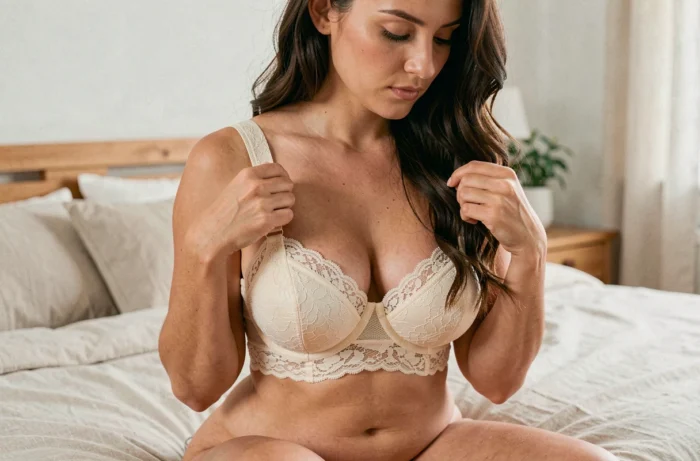
Full coverage underwired bras: the cut that stabilizes lower volume
The full coverage bra remains the most functional cut for a pear-shaped bust. Its cups rise high on the breast and cover almost the entire breast surface. The lower part of the cup, deeper, captures the volume without compressing it.
The underwires play a structural role, not a compressive one. They distribute the weight of the breast along the underband instead of concentrating it on the straps. For a pear shape, this redistribution is crucial: it prevents the downward pull that causes red marks and discomfort by the end of the day.
The point of caution concerns the upper cup. On a poorly chosen full coverage bra, the upper fabric gapes. Look for models where the upper part is slightly stretched or cut on the bias, sometimes called enveloping cups. Some brands specializing in deep cups now design full coverage bras with a more open cut at the top and more coverage at the bottom, suitable for off-center or pear-shaped breasts.
Balconette and demi-cup: filling the top of the neckline without trickery
The balconette cuts the cup at mid-height of the breast. The straps are positioned on the sides rather than in the center, which naturally lifts the volume upwards and inwards. For a pear-shaped bust, this redistribution effect fills the typical hollow of the upper pole.
The demi-cup works on a similar principle but with slightly less covering cups. It creates a more rounded neckline. Both cuts share an advantage: they do not try to force the breast into a predefined shape, but rather accompany its natural projection.
- The underwired balconette is suitable for medium to generous pear-shaped breasts, as it combines side support and lifting of the upper volume.
- The demi-cup without rigid cups better accommodates the frequent asymmetries in this morphology, with the soft fabric adapting to the actual filling of each breast.
- A light push-up (with a thin pad only in the lower part of the cup) can complement the balconette by filling the upper hollow without flattening the lower volume.
The common pitfall: choosing a cup size based on the top of the breast (too small) instead of the fullest part. The cup size is always determined at the point of maximum projection, here the base of the breast.

Straps, band, and adjustments: the details that change support
Beyond the cut, three structural elements directly influence the comfort of a pear-shaped bust.
Wide straps and off-center positioning
Narrow straps concentrate pressure on a small area of the shoulder. For a bust whose weight pulls downwards, straps at least one centimeter wide distribute the load better. Their slightly off-center positioning towards the outside (as on a balconette) prevents frequent slipping on narrow shoulders.
Properly adjusted underband
The band provides most of the support. An overly loose band transfers all the weight to the straps, worsening the pulling effect. The test is simple: the band should remain horizontal at the back, without riding up. If two fingers can fit underneath, the fit is correct. Beyond that, the back size is too large.
Underwires and root width
The width of the underwire should match the root of the breast. On a pear-shaped bust, the root is often wider at the bottom than at the top. An underwire that is too narrow compresses the lower lateral volume and pushes the breast forward instead of supporting it. Some brands offer asymmetrical underwires that are wider at the base, better suited to this geometry.
Wireless bras and textile alternatives for the pear shape
Wireless bras are not contraindicated for this morphology, provided that the absence of structure is compensated by other means. A model in soft compression technical fabric, with reinforcement seams under the cup, properly supports pear-shaped breasts of small to medium volume.
For more generous volumes, wireless support reaches its limits. An additional avenue worth mentioning: some garments with internal construction (integrated bras, support seams in the bodice) offer distributed support across the entire bust, limiting localized pulling under the breast. This approach, documented by bloggers specializing in morphology, does not replace lingerie but can reduce reliance on a bra for short durations.
The pear shape is an anatomical variant among others, neither a problem to correct nor a rare peculiarity. Choosing a suitable bra relies on three concrete markers: a cup sized at the point of maximum projection, an underband that truly carries the weight, and a cut (full coverage, balconette, or demi-cup) that accompanies the natural distribution of volume instead of opposing it.